An introduction to Abraham Maslow

Abraham Maslow Hierarchy of Needs

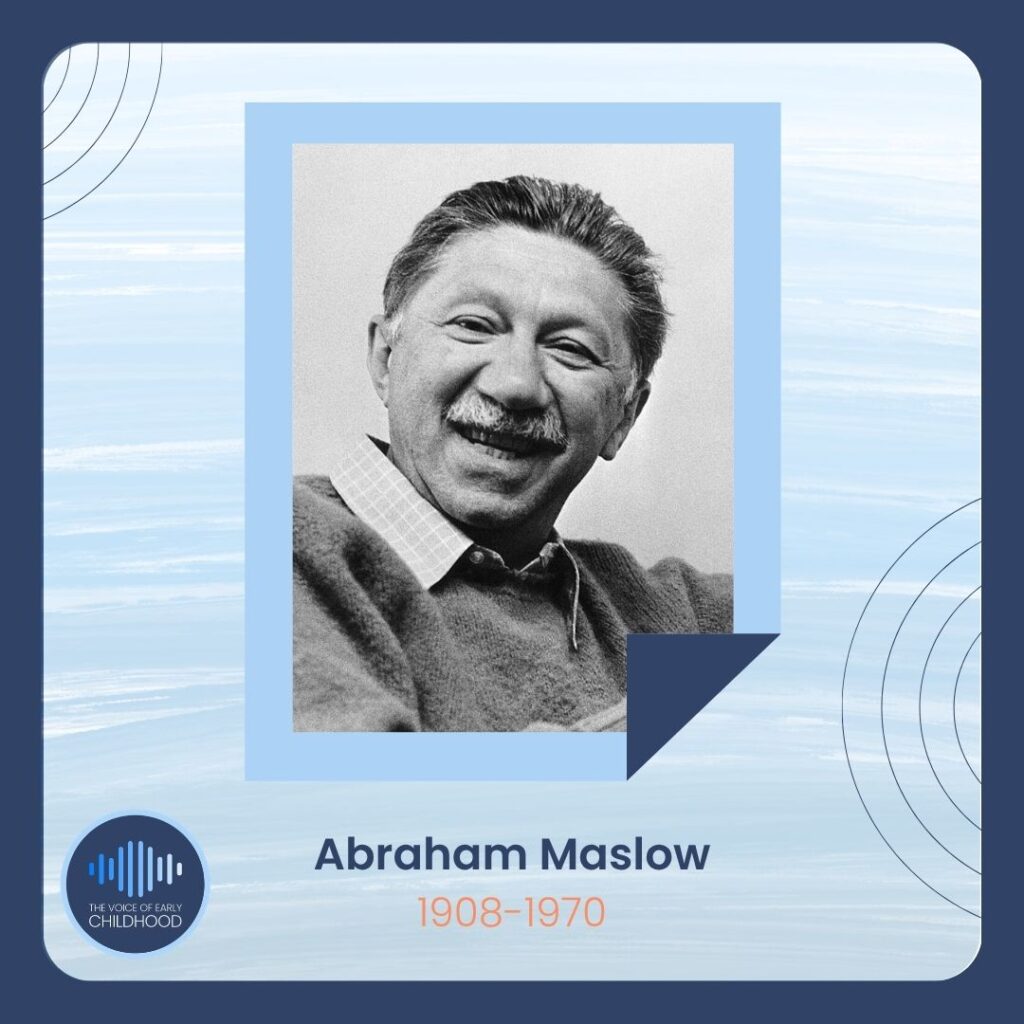
Who was Abraham Maslow?

Abraham Maslow (1908–1970) was an American psychologist best known for founding humanistic psychology and developing the hierarchy of needs. Born in Brooklyn, New York in 1908, Maslow focused on human motivation, growth, and potential, offering a more optimistic perspective compared to Freud and other behaviourists. His work remains central in education and psychology (Maslow, 1943; Maslow, 1954).

Maslow’s hierarchy of needs

Maslow’s hierarchy of needs says that all humans share the same types of needs, and that these categories of needs have a hierarchy. He proposes that human motivation follows a layered structure, often represented as a pyramid. At the base are physiological needs (food, shelter, sleep), followed by safety needs, love and belonging, esteem, and finally self-actualisation. He argued that individuals must have lower-level needs reasonably met before progressing to higher levels of growth and fulfilment (Maslow, 1943; Huitt, 2007).

Deficiency and growth needs

He differentiated between deficiency needs (basic survival and security) which are the first levels of the pyramid and growth needs (personal development and fulfilment). Deficiency needs must be consistently met in early years settings (nutrition, safety, belonging, esteem). Growth needs encourage creativity, exploration, and learning, supporting children to thrive and reach their potential (Maslow, 1954).

Self-actualisation

In Maslow’s hierarchy of needs, self-actualisation is the highest level – becoming the best version of oneself and achieving one’s unique full potential (Maslow, 1962).

 For young children, this doesn’t mean they have a fixed “end goal,” but rather that they are given the space, time and support to:

  • Be curious and explore.
  • Develop their unique talents and personality.
  • Express themselves freely.
  • Gain confidence in their abilities and self-belief.

Self-transcendence

Self-transcendence was later added to his theory. It means going beyond the self – connecting with others, showing empathy, caring for the environment, and contributing to something bigger (Maslow, 1962).

In early years, it doesn’t necessarily mean deep spirituality, but rather developing kindness, empathy, cooperation, and a sense of belonging to a community.

Links to today’s practice

  • Early years educators can use Maslow’s hierarchy to ensure children’s basic needs (nutrition, safety, comfort) are met before focusing on learning goals. This links to daily routines, key person systems, risk assessments and policies and procedures.
  • Encouraging a sense of belonging through relationships and play builds children’s emotional security. Staff should have an expert knowledge of each child, be there for them and show them loving care and attention.
  • Supporting self-esteem through praise, autonomy, and recognising effort helps foster resilience. Staff members should be on hand to support children through all the ups and downs of the day and show encouragement and care.
  • Providing opportunities for creativity, problem-solving, and exploration nurtures self-actualisation. Each child is unique, and it is the role of settings to support children to reach their own unique full potential.

(Huitt, 2007; Boddey, 2025).

How might Maslow have extended his theory today?

Maslow might have expanded his theory to reflect cultural diversity and modern challenges, such as digital wellbeing, climate anxiety, and the importance of community connection in an increasingly globalised world.

Links or challenges to other pioneers/theory

Maslow’s holistic approach aligns with Montessori’s emphasis on the prepared environment and nurturing the whole child.

Maslow’s work also links very well to Carl Rogers’ theory and the person-centred approach. In this approach the individual is seen as the expert on their own life and we, as adults can support them to reach their own unique full potential (Gawel, 1997).

Key takeaways

  • Maslow developed the hierarchy of needs, a model that can be used in early childhood and wider education to support each child to flourish and develop.
  • Human needs range from survival basics to growth-focused self-actualisation.
  • Education should prioritise wellbeing (safety, security, love, self-esteem) before academic learning. Only when children have caring relationships with others, when their basic needs are met and they feel safe and secure will they be able to learn and develop.
  • His theory underpins holistic, child-centred approaches in early years practice.

Critical considerations

    • The theory tends to generalize human behaviour without accounting for personal differences. People may have different needs that are more significant to them based on personal, situational, or cultural factors, which the hierarchy does not fully accommodate.
    • The hierarchy suggests a linear progression of needs, implying that one level must be fulfilled before moving to the next. However, research suggests that human needs are more interconnected and overlapping than hierarchical, and people can pursue needs at different levels simultaneously.
    • An important consideration is whether the theory can be applied universally across cultures or not.
    • We do not live our lives independently and instead we are all interconnected. Maslow’s theory does not take this into account and therefore I recommend complimenting this theory in your practice with a theory that highlights connections with nature, others and community such as the Ubuntu Philosophy.

    (Neher, 1991; Tay & Diener, 2011).

Explainer

Self-actualisation: Achieving one’s fullest potential through creativity, authenticity, and growth.

Deficiency needs: Basic needs that must be fulfilled to prevent deprivation (e.g., food, safety).

Growth needs: Higher-level needs that promote personal development (e.g., self-esteem, learning).

Self-transcendence: Moving beyond the self to focus on altruism, spirituality, or collective wellbeing.

Ubuntu: The philosophy of Ubuntu is a South and Southern African worldview centred on the belief that “a person is a person through other people,” (Mugumbate, 2013).

References

Boddey, J (2025) The Marvelous Maslow https://www.earlyinsights.co.uk/post/the-marvellous-maslow

Maslow, A. H. (1943). A Theory of Human Motivation. Psychological Review, 50(4), 370–396.

Maslow, A. H. (1954). Motivation and Personality. Harper & Row.

Huitt, W. (2007). Maslow’s Hierarchy of Needs. Educational Psychology Interactive. Valdosta State University.

Maslow, A. H. (1962). Toward a Psychology of Being. Van Nostrand.

Gawel, J. E. (1997). Herzberg’s Theory of Motivation and Maslow’s Hierarchy of Needs. Practical Assessment, Research & Evaluation, 5(11).

Neher, A. (1991). Maslow’s Theory of Motivation: A Critique. Journal of Humanistic Psychology, 31(3), 89–112.

Tay, L., & Diener, E. (2011). Needs and Subjective Well-Being Around the World. Journal of Personality and Social Psychology, 101(2), 354–365.

Mugumbate, Jacob and Nyanguru, Andrew, “Exploring African philosophy: The value of ubuntu in social work” (2013). Faculty of Social Sciences – Papers. 3266.

Reference this article

Boddey, J. 2026. An introduction to Abraham Maslow. The Voice of Early Childhood. Available at: www.thevoiceofearlychildhood.com/introduction-abraham-maslow/

About the author

  • Early years advisor at Early Insights

    After 20 fun and exciting years working in early years I am now an early years consultant, supporting settings to develop a child centred approach to practice. My setting was twice graded Outstanding by Ofsted and was awarded multiple nursery awards. I am passionate about child centred practice, humanistic development and joy in early years.

    View all posts

Want to book one of our writers for a conference, training day or project?

You might also be interested in...

Follow us and share your voice