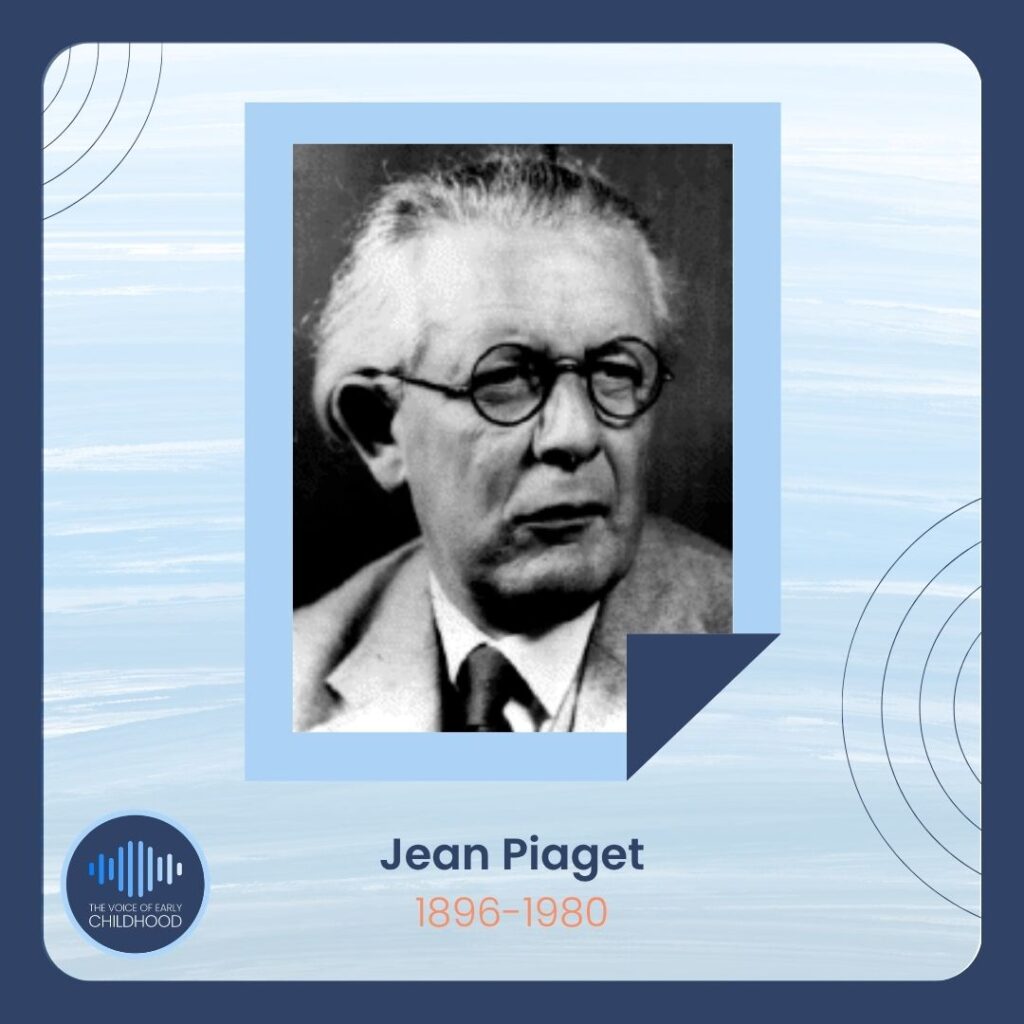
Jean Piaget (1896–1980) was a Swiss psychologist widely recognised as one of the most influential theorists in the field of child development. His work has significantly shaped our understanding of how children learn and develop cognitively, with lasting implications for early childhood education. Piaget’s theory of cognitive development continues to inform contemporary pedagogical approaches, emphasising the active role of children in constructing knowledge through interaction with their environment.
Piaget’s theory of constructivism
Piaget’s work was grounded in the idea that children are not passive recipients of knowledge but active participants in their own learning. He introduced the concept of ‘constructivism’, which suggests that children build their understanding through hands-on experiences and interactions with the world around them (Piaget, 1972). This perspective has had a profound influence on early childhood education, shaping approaches that prioritise exploration, discovery, and problem-solving.
The four stages of cognitive development
A key aspect of Piaget’s theory is the idea that children progress through four universal stages of cognitive development, each characterised by distinct ways of thinking and understanding the world (Piaget, 1952).
Piaget’s interest in the way children think was sparked while working on standardised intelligence tests. He observed that children consistently made similar errors at particular ages, leading him to propose that cognitive development occurs in the following distinct stages (Piaget, 1952):
Sensorimotor stage (birth to two years) – At this stage, infants learn through sensory experiences and physical interactions. They develop object permanence, understanding that objects continue to exist even when out of sight.
Preoperational stage (two to seven years) – Children begin to develop language, symbolic thinking, and imagination. However, their thinking is often egocentric, meaning they struggle to see situations from perspectives other than their own.
Concrete operational stage (seven to 11 years) – Logical thinking emerges, and children become capable of understanding concepts such as conservation, classification, and cause-and-effect relationships. However, their thinking remains tied to concrete objects and experiences.
Formal operational stage (11 years and beyond) – Abstract reasoning develops, allowing children to think hypothetically, consider multiple perspectives, and engage in complex problem-solving.
Piaget argued that children progress through these stages at their own pace, constructing knowledge through active exploration and social interaction (Piaget, 1972). This has important implications for early childhood education, highlighting the need for developmentally appropriate practices that support children’s natural learning processes.
Implications for early childhood education
Piaget’s theory has deeply influenced early childhood pedagogy, reinforcing the idea that children learn best through active engagement rather than passive instruction. His work underpins many play-based and child-centred approaches, which encourage exploration, experimentation, and hands-on learning experiences (Wood, 2020).
Educators who are influenced by Piaget’s perspective recognise the importance of providing rich learning environments where children can manipulate objects, engage in problem-solving activities, and construct their own understanding. This aligns with the view that learning should be a process of discovery rather than direct transmission of information (Robson, 2019). Additionally, Piaget’s emphasis on developmental stages reminds educators to be mindful of children’s cognitive abilities and to provide experiences that align with their current level of understanding. This means offering open-ended materials, encouraging questioning, and allowing children to take the lead in their learning.
Critical reflections on Piaget’s theory
While Piaget’s contributions to our understanding of cognitive development are widely acknowledged, his theory has also been subject to critique. Some researchers argue that cognitive development is more fluid and less stage-like than Piaget suggested (Siegler, 2005). Others highlight the role of social and cultural influences, which Piaget downplayed in comparison to theorists like Lev Vygotsky (Fleer, 2018).
Reflecting on Piaget’s work in the context of early childhood education, we might ask:
How do we balance structured learning experiences with opportunities for child-led exploration?
In what ways can we incorporate social and cultural influences into our understanding of children’s cognitive development?
How can educators use Piaget’s insights while also considering more contemporary research on learning and development?
Foundational influence on early childhood education
Jean Piaget’s theory of cognitive development remains a foundational influence in early childhood education. His constructivist approach continues to inform practices that emphasise active learning, discovery, and developmental appropriateness. While later research has built upon and refined his ideas, Piaget’s work provides valuable insights into how children think, learn, and make sense of the world.
By considering both the strengths and limitations of Piaget’s theory, educators can create learning environments that support children’s cognitive growth while also embracing the complexity and individuality of their developmental journeys.
References
Fleer, M. (2018). Conceptual playworlds for wellbeing and cultural identity: A Vygotskian approach to early childhood education. Cambridge: Cambridge University Press.
Piaget, J. (1952). The origins of intelligence in children. New York: Norton.
Piaget, J. (1972). The psychology of the child. New York: Basic Books.
Robson, S. (2019). Developing thinking and understanding in young children: A reflective approach. 3rd edn. London: Routledge.
Siegler, R. S. (2005). ‘Children’s thinking: Cognitive development and individual differences’, Annual Review of Psychology, 56(1), pp. 1-23.
Wood, E. (2020). Play, learning and the early childhood curriculum. 4th edn. London: Sage.
Lecturer, podcast host and founder of The Voice of Early Childhood
Angelica is an early childhood advocate, lecturer and founder of The Voice of Early Childhood (TVOEC). Angelica is working on giving the early childhood sector a voice through TVOEC by encouraging shared reflection, dialogue, collaboration and healthy debate. Angelica’s areas of expertise are community building, networking, career progression and bridging the gap between academia and practice. She has worked in practice across various settings and in different roles, before moving into content creation aimed at enhancing training and development for both educators and parents across the globe. This has involved working in publishing, training, academia, events and resourcing learning environments.