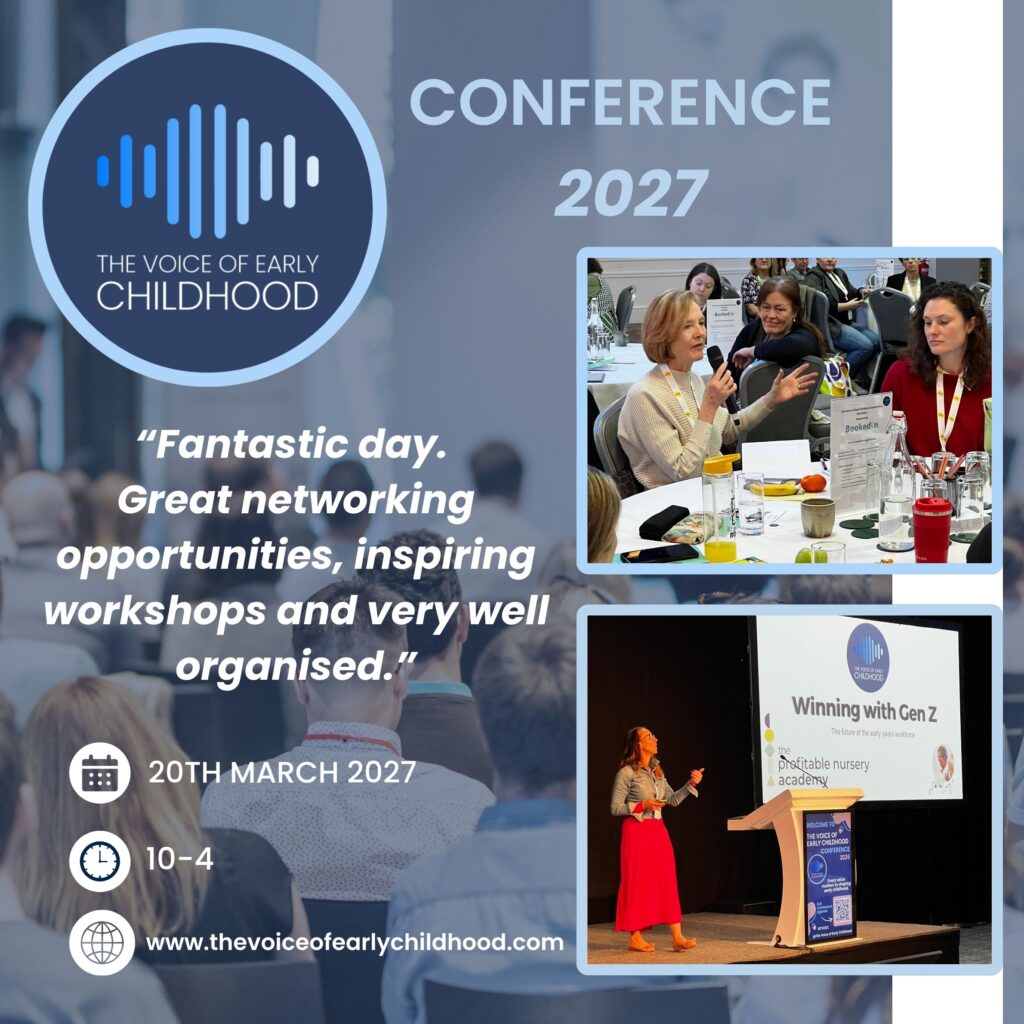
The Voice of Early Childhood Conference 2027
– Tickets are non-refundable
– We endeavour to cater for allergies and dietary requirements stated at ticket order
– Please note there will be a media team operating at the conference (photography, videography) for editorial and marketing purposes
– This is an over 16’s only CPD event
– Parking is available free of charge
£65.00
Availability: 184 in stock
Plan your day
Dr Jacqueline Harding
The importance of laughter for children’s brains
In this keynote, Dr Jacqueline Harding will present a groundbreaking exploration of the transformative power of laughter, hope and human connection in early childhood development.
Drawing on her own empirical research and evidence from biology, psychology, neurophysiology and sociology, she asks a provocative question: are humour, hope and human connection among the most powerful forces shaping children's cognitive development, emotional wellbeing and lifelong resilience?
Select one of the below talks during booking
Join author, educator and inclusion advocate Sukhy Kaur for a lively, interactive session exploring hats and headwear from around the world.
Through storytelling, sensory books, puppetry, audience participation and practical demonstrations, delegates will discover how to spark conversations about culture, identity, neurodiversity and belonging.
Expect plenty of energy, laughter and learning as Sukhy brings her characters to life in a workshop that delegates won't be able to take their eyes off.
Inclusion shouldn’t stop at the staffroom door. This session explores how to support neurodivergent educators by shifting from a deficit mindset to purposeful environmental design. Discover how valuing their unique strengths and preventing masking protects your staff, ensures adult co-regulation, and improves the classroom for everyone.
This session explores how adults can support children’s movement development by balancing guidance with playful exploration. Participants consider when to step in, when to step back, and how to create environments that nurture confident, capable movers across early childhood settings.
Select one of the below talks during booking
This session explores the powerful role of storytelling and characters in supporting young children’s learning, thinking, and emotional development. Drawing on research from learning sciences and classroom practice, it highlights how puppets and other “others” can help children engage with ideas, build empathy, and approach challenges such as early maths with greater confidence. Through practical demonstrations and real classroom examples, the session offers playful, research-informed strategies that practitioners can apply immediately in early years settings.
Children’s development during early childhood (or early years in the UK) arguably has the most impact on their future selves, however there’s still no real consensus on the best approach to policy or the delivery of high-quality practice. During this session I will explore some modern international perspectives which could underpin our practice today and influence our aspirations for the future of the sector.
Young children’s brains struggle more than adults to distinguish speech from background noise. Conor’s research uses wearable tech to test two noise-reduction strategies and their effects on language development. He will discuss what the research reveals about children’s responses to noise and methods to reduce its negative effects.
Select one of the below talks during booking
From Concern to Action: Strengthening Safeguarding Cultures in Early Childhood explores how early years practitioners can build safe, child-centred environments where concerns are recognised and acted upon confidently. Through practical strategies, case examples, and reflective discussion, participants will strengthen professional curiosity, early intervention, and everyday safeguarding practice to create a culture where every child feels safe, heard, and protected.
Maths is everywhere and every interaction is one in which to learn. Sometimes, it can be tricky to embrace these opportunities for meaningful, contextualised maths in the moment. This session aims to explore some of the reasons why educators may be less confident in seizing these mathematical opportunities and some practical ways to bring maths to life in simple, but significant, ways.
Early years practitioners are uniquely placed to recognise emerging needs and make a lasting difference to children's developmental outcomes. This engaging and thought-provoking seminar explores the critical role of early identification of Special Educational Needs and Disabilities (SEND), helping practitioners to recognise indicators of need and respond with confidence.
Drawing on current research in child development, neuroscience and SEND practice, the session will challenge traditional views of behaviour as simply communication, instead exploring behaviour through the lens of regulation. Participants will develop a deeper understanding of how children's sensory, emotional and neurological experiences influence their actions and interactions.
TBC


