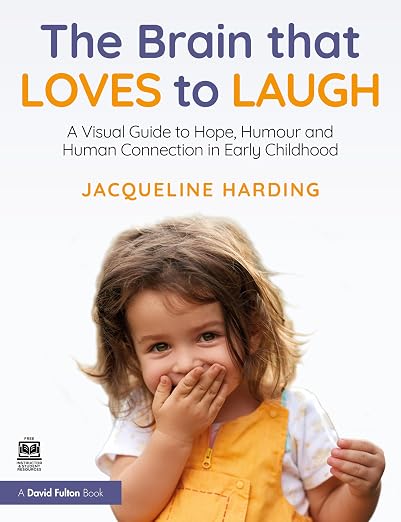
Bringing laughter into the light
Why do we devote so much attention to what goes wrong, while laughter, joy and hope remain at the edges of professional discussion?
This question sits at the heart of our conversation. Difficult emotions, adversity and developmental challenges rightly require careful attention. Yet a balanced understanding of children also asks us to consider what happens in the brain, body and relationships when children experience joy, safety and human connection.
Laughter is sometimes dismissed as frivolous. In educational spaces, it can even be interpreted as a distraction: something to manage before the ‘real’ learning can begin. We want to challenge that assumption.
Laughter is not separate from learning. It is part of the relational environment in which learning becomes possible. It can communicate: I see you. I am with you. You are safe enough to be curious here.
We arrive ready for connection
Human connection is fundamental to early development. Babies enter the world dependent on relationships with other people as they gradually organise their experiences, emotions and responses. We sometimes describe this as arriving in ‘pairing mode’, waiting for connection.
This connection is not created through a programme, resource or carefully scripted activity. It grows through everyday exchanges: eye contact, facial expression, movement, shared attention, playful moments and the ways adults respond to children’s emotional communication.
The adults around a child create an emotional ecosystem. Parents, educators, psychologists, social workers and other professionals all contribute to the atmosphere surrounding that child. Through repeated interactions, children begin to understand whether their feelings can be expressed, whether other people will respond and whether the world around them feels sufficiently safe to explore.
Laughter can be an important part of this ecosystem. However, it is not about arriving with a joke book or expecting adults to become performers. It is about meeting children where they are and being open to the forms of connection they offer. Sometimes this may involve silliness. Sometimes it may be a knowing look, an unexpected sound or a shared moment during play. The laughter matters because the relationship matters.
Joy does not mean being happy all the time
Taking joy seriously does not mean expecting children to be cheerful all throughout the day. Children need permission to experience the full force of their emotions. We want children to belly laugh, but we also want them to know that sadness, disappointment, anger and fear can be expressed. Healthy development does not depend on removing difficult emotions. It depends partly on children experiencing those emotions within relationships where they are recognised and supported.
Adults can sometimes feel uncomfortable when children are upset. We may move quickly to distract, reassure or solve the problem. Although this response often comes from care, it can unintentionally communicate that certain feelings are too much, unacceptable or something to escape.
There is an important distinction between supporting a child and requiring them to feel better for the adult’s comfort. Joy should not become another emotional expectation imposed on children. Shared laughter is valuable when it emerges through genuine connection, not when it is used to silence distress or avoid what a child is communicating. Our role is to help create environments in which the whole emotional range is possible.
Laughter as a companion to resilience
Experiences in very different communities have shown us how universal laughter can be.
Jawad’s work with children and families affected by war and displacement highlighted that joy can remain present even within profound uncertainty. Before children can explain their experiences through spoken language, they communicate emotionally – through crying, movement, expression and laughter.
This does not mean laughter removes hardship. Nor does it suggest that people experiencing adversity should simply become more positive. Joy is not the absence of struggle. Instead, laughter can become a companion to resilience: a moment of connection, humanity or relief within circumstances that remain difficult. It may offer a reminder that a child is more than what has happened to them.
Hope can operate in a similar way. Some children are surrounded by safe adults and strong protective relationships. Others may have fewer sources of safety. Educators and professionals cannot immediately resolve poverty, conflict, housing insecurity or every condition affecting a family’s life. It would be misleading to suggest that humour can compensate for structural inequality.
What we can do is consider the systems and relationships around children. We can ask whether our settings add pressure or provide steadiness; whether
children encounter judgement or respect; and whether the language surrounding them closes down possibility or leaves room for hope.
What joyful practice can look like
Jacqueline’s visit to a paediatric spinal rehabilitation unit in Kentucky offered a powerful example of connection within serious clinical work. The children, ranging from 18 months to 18 years, were taking part in demanding physical therapy. Yet throughout the unit, professionals were already using play, laughter and warm relationships to support engagement. Therapy sessions lasted for around an hour and a half, and Jacqueline observed that children remained involved in their exercises.
The seriousness of the children’s injuries had not led the adults to remove play. Instead, play and connection had become part of how the work was approached.
This experience challenges a common assumption: that the more serious the outcome, the more serious and controlled the process must appear.
Children do not necessarily engage most deeply when adults make learning or therapy feel heavy. Sometimes humour, movement and shared enjoyment help make sustained participation possible.
The same principle can be seen in educational settings. Jacqueline described work in schools where the curriculum was made more creative and joyful. Over eighteen months, the project reported improvements in attainment alongside reduced absence among both children and educators.
These observations do not mean laughter alone caused every change. They do, however, invite us to reconsider the conditions surrounding engagement. People are more likely to participate in spaces where they experience connection, belonging and possibility.
Play and laughter do the heavy lifting
Learning is often imagined as something that happens when children sit still, listen and complete tasks determined by adults. Play, by comparison, may be treated as a break from learning or a reward offered after the important work has been completed. We see this separation as deeply problematic.
Play and learning are not competing processes. Through play, children communicate, negotiate, experiment, revisit ideas and encounter uncertainty. They experience the consequences of their actions and respond to the actions of others. Humour often emerges naturally within this process because children are exploring incongruity, surprise, repetition and shared meaning.
When children feel safe and connected, curiosity has room to grow. When they feel like failures, curiosity can quickly diminish. Hope and humour can help reopen that space—not by removing challenge, but by making challenge feel more approachable.
This is why laughter should not be viewed as something that gets in the way of cognitive work. It may be part of the relational and emotional foundation that enables children to remain with that work.
What does a ‘good’ learning environment sound like?
A quiet room is not automatically a well-regulated or effective learning environment. Silence may sometimes indicate concentration. At other times, it may indicate compliance, anxiety, disconnection or a lack of opportunity for meaningful interaction. Noise and laughter are equally open to interpretation. They may be disruptive, but they may also signal collaboration, belonging and intellectual engagement.
We need to look beyond the volume of a room and consider what is happening within it. Are children laughing with one another as they construct a shared idea? Are they using playful language to negotiate relationships? Do they feel comfortable enough to make mistakes? Are adults joining children’s humour sensitively, or closing it down because it does not fit the planned pace of the day?
As children move through education, laughter can become increasingly restricted. The curriculum becomes more crowded and adults may feel there is no time for playful connection. Yet emotional intelligence, reciprocal communication and the ability to sustain relationships are not peripheral skills. They are central to how children participate in communities and navigate future uncertainty. If educational systems leave no room for human connection, we need to question what those systems understand education to be for.
Connection is not the same as losing boundaries
Some adults worry that allowing laughter will lead to chaos. They may fear that children will become ‘out of control’ or that a playful educator will lose authority. Our experience suggests that humour and boundaries do not have to be opposites.
Children are often more willing to engage with adults when they experience those adults as human, responsive and emotionally available. Shared laughter can strengthen rather than weaken the relationship. The important question is not whether humour is present, but how it is being used.
Humour should connect rather than humiliate. It should not depend on laughing at a child, exposing their vulnerability or requiring them to participate. Nor should it be used to minimise an experience that feels serious to them. Relational humour remains attentive to the child. It notices their response and changes course when necessary. This sensitivity matters because every child’s way of connecting will be different. What delights one child may overwhelm another. What feels playful within an established relationship may feel confusing or unsafe without that trust.
Emotional learning happens between people
Children do not learn emotional regulation only by being told the names of feelings. They learn through relationships and real situations: waiting, disagreeing, becoming frustrated, repairing conflict and discovering that an emotion can be experienced without bringing the relationship to an end.
Adults have an important co-regulatory role, particularly when children are overwhelmed. However, there are also times when adults can step back. When children are negotiating with siblings or peers, immediate intervention can remove an opportunity to practise problem-solving and regulation. This does not mean leaving children unsupported. It means observing closely and deciding whether adult involvement is needed, rather than assuming every difficulty must be resolved for them.
Play provides repeated opportunities for this emotional work. Within play, children encounter unpredictability, disagreement, excitement and disappointment. They practise recovering when an idea changes, when another child says no or when something does not go to plan. Laughter may sit alongside these experiences. So may tears. Both belong.
Taking joy seriously
Laughter should not remain in the shadows of educational practice simply because it appears light. Its lightness may be part of its power.
Shared laughter can invite curiosity, communicate safety and strengthen connection. It can sit beside grief, frustration and uncertainty without denying them. It can help adults and children experience one another as people rather than roles within a system.
This is not a call for constant entertainment. It is an invitation to notice what already happens between children and adults, and to question the practices that routinely interrupt it.
Perhaps the work begins with some simple observations:
- When does laughter emerge in our setting?
- What is it communicating?
- Do we welcome it, fear it or immediately attempt to control it?
- And what might become possible if hope, humour and human connection were understood not as extras, but as part of the serious work of education?