Publication date
Author
-
Professor Alison Clark (she/her)
Academic and consultant
The conversation on slow pedagogy
To celebrate 100 episodes of The Voice of Early Childhood podcast we have a very special guest with us…the pioneering Professor Alison Clark. Best known for advocating for the voice of the child through her pioneering research with Professor Peter Moss on the Mosaic Approach: A participatory, multimethod approach of listening to young children’s voices within qualitative research.
In this episode Professor Alison Clark discusses the underpinnings of slow pedagogy and its valuable impacts, including the notion that slow pedagogy honours childhood in its own right, yet equally prepares children for the future and therefore developing the vital 21st century skills.
The below information is taken from the Froebel Trust pamphlet Time for childhood: Slow pedagogy By Donna Greenwood and Professor Alison Clark.
To receive a free copy of the full pamphlet please sign up to our newsletter below.
Slow pedagogy in the 21st century
There are many downward pressures on the early childhood sector for young children and those who work with young children to be hurried. This impetus to hurry can take many forms, including from national testing and inspections and an emphasis on making children ‘school ready’. These pressures have become more significant post-pandemic as indicated by the influence of a ‘catch-up narrative’. This policy agenda pushes children to reach expected development goals against a background of a cost-of-living crisis. These factors may direct attention away from some of the core values in ECEC and reduce the opportunities to enjoy being with young children and sharing in their curiosity, creativity and energetic explorations of the world.
Slow pedagogy prioritises time for play, learning and relationships. It is relevant to a range of pedagogies that emphasize an unhurried approach to the relationship between children and adults and a valuing of care and creativity. Froebel advocated for the importance of childhood in its own right, not as a preparation for the next stage in life and he placed play centre stage. Froebelian educators ensure rich first-hand experiences and develop relationships with families, carers and the wider community. Froebelian pedagogy is a slow pedagogy.
What does slow pedagogy 'look like'?
Slow pedagogy is all about ‘being with’ – attentive to the rhythm of children, adults and materials. Can involve sudden, fast exchanges with children as well as slower moments. Values play and the present moment. Makes time to listen to children’s ideas and experiences through a range of expressive languages. Is attentive to strengthening relationships. Supports creativity and imagination and other abilities and attributes that are difficult to measure. Appreciates the group as well as individual children’s progress and wellbeing. Is respectful of children’s past experiences and cultures. Keeps longer term perspectives in view about children’s lives, about education and the planet. Can be a place of resistance when policies sit uncomfortably with pedagogical principles. (Adapted from Clark 2023). Slow pedagogy isn’t about being in ‘slow motion’. It is a way of engaging that is attentive to children and context and can include different rhythms, for example in dancing, singing, running, reading and being still.
Key takeaways
- Prioritising relationships and connection: Slow pedagogy emphasises the value of deep, meaningful relationships with children, families, and colleagues. It encourages educators to take time to connect and build trust, recognising the importance of social and emotional wellbeing for holistic development.
- Valuing unhurried time: The episode discussion and pamphlet highlights the importance of slowing down and allowing children the space to explore, wonder, and learn at their own pace. This approach honours children’s rhythms and fosters creativity, curiosity, and independent thinking.
- Child-led learning: Slow pedagogy champions following children’s interests, acknowledging their agency in the learning process. It encourages a shift from rigid, outcome-driven practices to more flexible, process-oriented ones.
- The importance of the environment: Slow pedagogy encourages creating rich, open-ended spaces that invite exploration and nurture children’s intrinsic motivation to learn.
- Resisting pressures of time and accountability: Educators are invited to reflect critically on the pressures of modern education systems, particularly those that prioritise measurable outcomes. Slow pedagogy offers an alternative grounded in values of care, respect, and relational learning.
Critical considerations
- How often do I create opportunities for unhurried exploration and play in my setting or home?
Reflect on whether your routines and schedules allow children to fully immerse themselves in play and learning experiences without feeling rushed. - Am I truly following the interests and ideas of the children I work with?
Think about how you engage with children’s agency. Are experiences and activities genuinely led by their curiosity, or are they shaped by external expectations? - How do I balance the demands of accountability with the wellbeing of children?
Consider how you navigate the tension between external pressures (e.g., assessments) and providing a meaningful, process-oriented learning environment. - Does the physical and emotional environment in my setting support slow pedagogy?
Reflect on the design and atmosphere of your space. Are there calm, inviting areas that promote engagement and connection? Do children feel safe and valued in the environment? - What role does collaboration play in my practice?
Slow pedagogy highlights the importance of building relationships with children, families, and colleagues. How do you actively cultivate these connections to enhance your practice and children’s experiences?
Useful links and further reading
Bruce, T. (2021) Friedrich Froebel. A Critical Introduction to Key Themes and Debates. London: Bloomsbury Academic.
Bruce, T. & Spratt, J. (2011) Essentials of Literacy from 0-7. London: Sage
Craft, A., McConnon, L. & Matthews, A. (2012) Child-initiated play and professional creativity: Enabling four-year-olds’ possibility thinking. Thinking Skills and Creativity, 7(1): 48-61. Available at: https://doi. org/10.1016/j.tsc.2011.11.005
Froebel, F. (1887) Froebel’s Letters on the Kindergarten. London: Swan Sonnenschein.
McCormick, C. (2012) Froebelian methods in a modern world: A case for cooking. In Bruce, T. (Ed.) Early Childhood Practice: Froebel Today. London: Sage, pp.137-154.
Tovey, H. (2017) Bringing the Froebel Approach to your Early Years Practice. 2nd ed. London: Routledge.
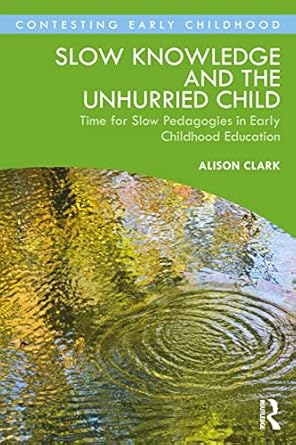
This book explores the relationship with time in early childhood by arguing for the valuing of slow pedagogies and slow knowledge. Alison Clark points to alternative practices in Early Childhood Education and Care that enable a different pace and rhythm, against the backdrop of the acceleration in early childhood and the proliferation of testing and measurement. Diverse approaches are explored to enable an ‘unhurried child’ and less hurried adults.
Watch the full podcast episode
About the author
-
Academic and consultantView all posts
Dr Alison Clark, Professor of Early Childhood Education, University of South-Eastern Norway and early childhood consultant based in Orkney, Scotland. Alison is a widely published early childhood academic who, together with Professor Peter Moss, developed the Mosaic approach (Clark and Moss, 2001; Clark, 2017), as a way of listening to and engaging with young children’s views and experiences. Her study ‘Slow knowledge and the unhurried child’ was funded by the Froebel Trust and published by Routledge. This book was named Professional Book of the Year in the Nursery World Awards 2023. Alison is engaged in research with practitioners about slow practices in ECEC in Scotland, Norway, Iceland and Japan. Based in Orkney, Scotland, she is also a practising artist.