Publication date
Author
-
Awajimijana Otana (he/him)
Lead paediatric audiologist at My Little Ears
Would you like to book one of our guests as a speaker, consultant or trainer?
The morning that changed everything
Every early years setting is under pressure to support speech, language and behaviour, yet there is a hidden hearing crisis affecting many of the children in your rooms right now.
For one 3‑year‑old girl, “Amelia”, that crisis quietly shaped how adults saw her, until a simple glue ear check revealed what was really going on.
December 7th 2023 began like any other clinic morning. I had just brought in my second patient of the day: a 3‑year‑old girl, small legs dangling off the edge of the chair, clutching a soft toy that looked far too big for her hands. Her mum sat down and exhaled in a way that spoke of months of quiet worry. “She’s always been bright,” she said. “But lately the nursery keeps saying she ‘doesn’t listen’… and at home she just seems in her own world.”
As a paediatric audiologist, versions of this sentence were painfully familiar. But that morning, something about this little girl stayed with me in a different way. Maybe it was because I had also become a parent and had a 3-year-old daughter myself, I’m not sure.
When I spoke to Amelia, she smiled politely but often looked at her mum, as if checking she had understood the question correctly. On paper, she was “fine”: no dramatic history, no big red flags. In reality, her world had become slightly muffled, just enough to shift how adults viewed her, from “engaged and curious” to “dreamy and not listening”.
A silent condition with loud consequences
Tympanometry – a quick, painless check of how the eardrum is moving showed what my gut already suspected: glue ear.
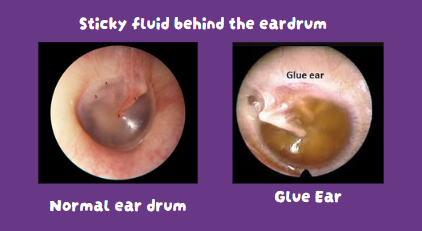
For Amelia, that meant sticky fluid sitting behind the eardrum, affecting how sound travelled through to the inner ear. When glue ear is present on tympanometry, there is a high likelihood that a child has a temporary hearing loss, even if they are not complaining of “ear problems”.
As I shared the news with her Mum, her face seemed to go through three emotions in seconds which she later confirmed was true:
- Relief that it wasn’t “just” behaviour.
- Guilt that this had likely been going on for months.
- Fear about what it might mean for her daughter’s learning and speech.
In that moment, the familiar frustration crashed over me again. Why were we still picking up children like Amelia only once they were already being labelled in their nursery as “not listening”, “distracted” or “behind”?
The realisation: We were starting in the wrong place
Walking back to my desk after that appointment, one thought would not leave my mind:
“We should never be meeting children like Amelia for the first time this late.”
By the time a 3‑ or 4‑year‑old reaches a paediatric audiology clinic, glue ear has often been silently present long enough to affect speech, language, attention and behaviour, in most cases. The clinic was doing its job, but it was the wrong starting point.
The right place to begin was where children spend their days:
- On the carpet for story time.
- In the busy nursery room, trying to follow simple instructions.
- In Reception, learning early phonics and relying heavily on clear hearing.
The epiphany was simple but profound:
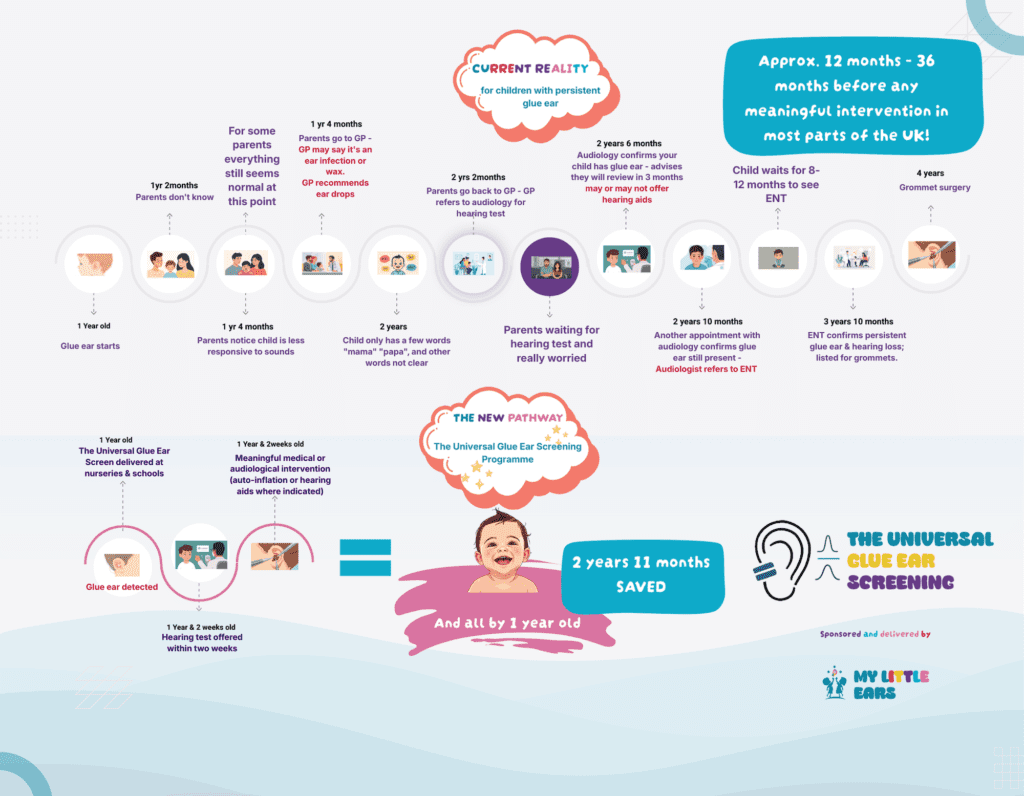
If we are to prevent temporary hearing loss due to glue ear causing speech delay and other issues, we need a universal, termly glue ear check in nurseries and schools – a preventative platform that detects glue ear almost as soon as it sets in, and certainly before learning is derailed.
That moment with Amelia became the turning point that led to the Universal Glue Ear Screening Programme.
What glue ear actually is (and why it hides so well)
Glue ear is a very common condition where sticky fluid builds up behind the eardrum and stops it moving freely. Tympanometry helps us see whether that fluid is present by checking how the eardrum responds to small changes in air pressure.
When glue ear is present, there is a high likelihood that a child will have a temporary hearing loss. Crucially, glue ear is often painless, which is why it slips under the radar.
There is no dramatic earache, no crying at night, just a gradual, quiet change in how clearly a child hears speech and environmental sounds.
The scale of this hidden hearing crisis is much bigger than most early years professionals realise:
- Around 20% of children under the age of 5 may be temporarily “deaf” due to glue ear at any one time in the UK.
- 8 in 10 children will experience at least one episode of glue ear before the age of 10 – almost no child escapes entirely.
For a toddler trying to tune into language and early social cues, even a moderate temporary hearing loss can have very real consequences. They may miss parts of instructions, struggle to follow group times in noisy rooms, or appear to ignore adults because they simply did not clearly hear what was said.
From the outside, this often looks like a behaviour issue, an attention problem, or a “slow to talk” child. Inside the middle ear, however, the picture is much simpler: sound is being dampened before it even reaches the inner ear.
The invisible impact in early years settings
For nurseries, childminders, and schools, glue ear is a “hidden” issue. Children rarely come in announcing they cannot hear well.
Instead, staff notice subtle patterns:
- A child who always turns the same ear towards you.
- The “daydreamer” on the carpet who misses the cue to join in.
- The child who seems fine one month, then suddenly appears to fall behind with listening and attention.
Because glue ear is often temporary, and may fluctuate, these patterns can be confusing. On some days the child seems to hear better than others, which can lead adults to doubt their own observations. Yet, multiplied across a classroom, the impact is huge.
If around one in five under‑5s may be affected at any given time, then in a busy nursery there could be several children experiencing a muffled world right now – without anyone realising.
The hardest part? In some parts of the UK, children can wait 12–36 months for an assessment or any meaningful medical or audiological intervention, losing incredibly important developmental time while everyone “waits and sees”.
From frustration to a new preventative children’s hearing platform
After that morning with Amelia, it became impossible to accept that “waiting until someone notices” was the best we could do.
Together with colleagues, the question became:
“What would it look like if we stopped chasing glue ear and started catching it early?”
The answer evolved into a practical framework designed specifically for early years settings:
- A glue ear check, not a hearing test
The focus is on identifying whether glue ear is present using tympanometry, as a proxy for likely temporary hearing loss, rather than trying to run a full diagnostic hearing test within a nursery or school. - Universal and termly
Every child in the setting is offered a quick, non‑invasive glue ear check once a term, not just those already flagged as “behind” or “difficult”.
This is a proactive rather than reactive approach that helps us catch glue ear early, and give parents and teachers advice on treatment pathways and communication strategies in a timely fashion. It is important that the Universal Glue Ear Screening programme is performed every term as glue ear will re-occur in 19-40% of children. - On‑site and simple for staff
The checks happen in the familiar setting, carried out by trained professionals, so there is no additional burden on staff and no need for families to travel or navigate long waiting lists. - Clear, supportive follow‑up
When glue ear is detected, parents receive clear information and guidance on the next steps, so they are not left to interpret medical jargon or work out the system alone.
This became the Universal Glue Ear Screening Programme, sponsored by My Little Ears, offered free to nurseries, schools, and early years settings as a preventative safety net for children’s hearing in the most critical years of development, rather than a crisis response.
In the podcast, we talk more about why glue ear is so common for this age group.
Addressing understandable worries in settings
When the programme was first shared with early years leaders, there were natural concerns:
- “Will this add more to our workload?”
- “What if parents panic if we say their child might have glue ear?”
- “We already have so much to think about – is this really necessary?”
These questions are both reasonable and important. Any new initiative must respect the reality of busy rooms, limited staff, and tight budgets.
What settings quickly discovered, though, was that the Universal Glue Ear Screening Programme is designed to reduce uncertainty, not add complexity:
- The glue ear checks are organised and delivered by the My Little Ears team.
- Staff are involved in a light, collaborative way, not asked to become mini‑audiologists.
- Parents receive clear, reassuring communication that explains glue ear as common and treatable, rather than something to be afraid of.
In the first settings that ran the programme, leaders saw children identified who had never been on any “watch list”. These were the quiet ones, the compliant ones, the ones who did not cause disruption but were quietly missing details in the classroom.
One Headteacher reflected: “Without this, we would have assumed this child just wasn’t trying in phonics. Now we know she literally couldn’t hear everything we were saying.”
That is the difference between reacting to “behaviour” and understanding the underlying barrier.
Why early years professionals are uniquely placed to protect hearing
Early years professionals are already experts at noticing small changes in behaviour, mood, and engagement. You notice when a child suddenly becomes more withdrawn, or when they stop joining in at group time. By adding a routine, termly glue ear check, you gain a powerful tool that matches your observational skills with a simple, clinical measure. Instead of wondering “is it behaviour, is it language, is it hearing?”, you can confidently rule glue ear in or out.
This matters because:
- Hearing underpins language, social interaction, and learning.
- Early intervention can prevent later difficulties in school.
- Families feel supported by their setting, not judged, when concerns are raised with clear evidence and a pathway forward.
In other words, you are not just managing behaviour or progress data, you are actively protecting one of the core foundations of a child’s development.
What early years settings can do next
For nurseries, schools and childminders, there are two powerful, practical steps to respond to this hidden hearing crisis: learn to recognise glue ear, and build routine glue ear checks into your setting.
Step 1: Take the Glue Ear Awareness Course
This short, free practical online course is designed specifically for early years professionals and parents of young children.
It explains how glue ear presents in real children in nurseries and schools, what signs to look for day‑to‑day, and how early identification and routine screening create a faster, clearer pathway for support.
Who is it for?
- Nursery staff and managers
- Childminders
- Nannies
- Early years and primary school staff
- Speech and language therapists
- Parents and carers
- Any professional working with or caring for young children
How to access the course
- Visit: www.mylittleears.co.uk
- Click on the “Take Course” button
- Complete the short form and you will receive an email with your access details
- For any questions about the course or access, email: hear@mylittleears.co.uk
Step 2: Become a proactive hearing care partner for free
Once your team has completed the Glue Ear Awareness Course, your setting can become a proactive hearing care partner at no cost. This is where knowledge turns into everyday hearing protection for the children in your care.
After the course, nurseries, schools and childminders can immediately join the Universal Glue Ear Screening Programme, which:
- Provides free, termly glue ear checks (using tympanometry) for children in your setting.
- Offers earlier support and tailored glue ear advice for families.
- It is fully sponsored by My Little Ears, so there is no fee for participating settings.
How to join the Universal Glue Ear Screening Programme
- Visit www.mylittleears.co.uk
- Click on “Become a Nursery Partner” or “Become a School Partner” and complete the short registration form
- A member of the My Little Ears team will contact you to organise your first Universal Glue Ear Screening Day
- Alternatively, email hear@mylittleears.co.uk to register your setting or ask questions
The Early Years Alliance who are England’s largest early years membership organisation and a registered charity, representing over 14,000 members (like nurseries, childminders, and playgroups) to provide support, training, and a unified voice for quality, affordable early education for over 800,000 families are our advocacy partners on this project. You can attend the Family Connect session on Glue Ear here. They also encourage their members to attend the Glue Ear Awareness course.
A new standard of hearing care for children: From “hope we notice” to “we routinely check”
The Universal Glue Ear Screening Programme exists to make what happened to Amelia, and hundreds of thousands of other children, far less likely to happen again. Instead of trusting chance, hoping someone notices, hoping a parent mentions concerns, hoping a child gets referred quickly, early years settings can embed a system that checks for glue ear every term, for every child.
For nurseries, childminders, and schools, this means:
- You can say, with confidence, that you are proactively safeguarding children’s hearing.
- You have a clear, clinically informed process for catching glue ear early.
- You are not left guessing when a child seems “off” – you have data and a pathway.
And because the programme is fully sponsored by My Little Ears, there is no cost to your setting.
For children like Amelia, it means more of their early years are spent fully tuned in to the sounds of stories, songs, and friendships, not quietly straining to hear in a world that seems just a little too far away.
This article is a starting point; in the podcast episode with The Voice of Early Childhood, there is space to explore glue ear, early identification and practical strategies in even more depth, alongside questions, reflections from our experience so far.
🎧 Hear us delve deeper into this topic by listening to the podcast episode
See the YouTube video below ⬇️ or click on the link at the top of this article
Key takeaways
- Glue ear is extremely common, often painless and easily missed, yet can temporarily reduce hearing for up to 1 in 5 under‑5s at any time and 8 in 10 will have at least one episode before age 10.
- Even a moderate temporary hearing loss can affect speech, language, learning and behaviour, so children may be seen as “not listening” or “behind” when they simply cannot hear clearly.
- A simple glue ear check using tympanometry can quickly identify likely temporary hearing loss due to fluid behind the eardrum in early years settings.
- Universal, termly glue ear checks in nurseries, schools and childminding settings provide a preventative safety net in the critical early years.
- The Universal Glue Ear Screening Programme and Glue Ear Awareness Course are free, practical ways for settings to become proactive hearing care partners for children and families.
Critical considerations
- Settings need clear, sensitive communication with parents and carers so glue ear findings feel supportive rather than alarming, with a clear explanation that it is common and usually temporary.
- Time, space and staffing need to be planned so termly glue ear checks fit smoothly into existing routines without overloading teams.
- Follow‑up pathways (GP, audiology, ENT, and classroom strategies) should be agreed locally so children identified with glue ear do not face long delays.
- International readers may need to adapt prevalence figures, referral routes and terminology to match their own health and education systems.
- Staff training in recognising signs of temporary hearing loss is essential so screening results are linked to everyday observations and classroom support.
Explainer
- Glue ear/otitis media with effusion (OME): A build‑up of sticky fluid behind the eardrum that restricts its movement and often causes temporary hearing loss, usually without pain.
- Tympanometry: A quick, non‑invasive test that measures how the eardrum moves in response to small changes in air pressure, used to detect fluid (glue) in the middle ear.
- Temporary hearing loss: A time‑limited reduction in hearing sensitivity (often due to glue ear) that may fluctuate but can still impact speech, language and learning.
- Universal screening: Offering a check to all children in a setting, not only those with concerns.
- Early years settings: Nurseries, preschools, childminders, nannies and early primary classes (e.g. Reception) that care for and educate young children, often under 7 years of age.
Further reading
Bluestone, CD & Klein, JO 2007, ‘Otitis media with effusion in children’, Canadian Family Physician, vol. 53, no. 12, pp. 2147–2152.
Cengel, S & Akyol, MU 2011, ‘Prevalence of otitis media with effusion among primary school children in Istanbul’, Journal of International Advanced Otology, vol. 7, no. 2, pp. 199–204.
Maw, AR 2011, ‘Otitis media with effusion in children’, BMJ Clinical Evidence, 2011: 0502.
National Deaf Children’s Society (NDCS) 2025, Understanding glue ear in children and temporary deafness, NDCS, London, viewed 18 January 2026, https://www.ndcs.org.uk/advice-and-support/all-advice-and-support-topics/causes-types-and-signs-deafness/causes-deafness-and-hearing-loss/glue-ear
National Institute for Health and Care Excellence (NICE) 2023, Otitis media with effusion in under 12s: diagnosis and management (NG233), NICE, London.
NHS England 2024, Making a decision about glue ear if your child has hearing loss, NHS England, London.
Syamil, N, Primarti, RS, Budiman, BJ, Afif, SH & Helmi, AF 2022, ‘Factors affecting the occurrence of otitis media with effusion in preschool and elementary school children: a comparative cross-sectional study’, BMJ Open, vol. 12, no. 9, e065291.
Zhao, C, Wang, J & Zhang, Y 2019, ‘Otitis media with effusion in children: pathophysiology, diagnosis, and treatment’, World Journal of Otorhinolaryngology – Head and Neck Surgery, vol. 5, no. 1, pp. 13–19.
Watch the full podcast episode
About the author
-
Lead paediatric audiologist at My Little EarsView all posts
Awajimijana is the lead paediatric audiologist at My Little Ears, where he leads the Universal Glue Ear Screening Programme across early years settings in the UK. Through this initiative, he is working to ensure that every child from nursery to Year 2 has access to free, early glue ear screening, improving detection and intervention at a critical stage of development. He holds an MSc in Audiology from the University of Manchester and has been recognised with two national awards from the British Academy of Audiology for his contributions to clinical practice and research. Awajimijana also holds an MBA from University College London, where he specialised in health systems innovation, combining clinical expertise with strategic insight to improve access, outcomes, and scalability in paediatric hearing care.