Proactively promoting positive mental health

Publication date

2 September 2024

Author

Too often we have a reactive over a proactive approach to mental health, focusing on mental ill health rather than on thriving. Matt Bawler shares his work around this, including establishing strong foundations and providing children with the tools and agency to be able to thrive in life.

Using stories to proactively promote positive mental health in young children

Introduction: An emotional education

This journey, for me, all started a number of years ago now. She was one of the most challenging children I have ever taught. It was her nursery year and one of our daily story times. The usual behaviours of doing everything she could to disrupt the class with banging and hurting other children were going on, but all of that stopped in an instant as she became transfixed by the story. As I slowly read ‘Mr Pusskins’ by Sam Lloyd, it became clear that this wonderful child had been grabbed by the worry of the cat in the story; that her owner didn’t love her anymore. The cat had done some bad things and was now waiting to see if the girl was going to come and get her. I could tangibly feel the genuine anguish and worry coming from the eyes and heart of this young girl who clearly resonated with something of a deeper feeling that she might not be lovable herself.

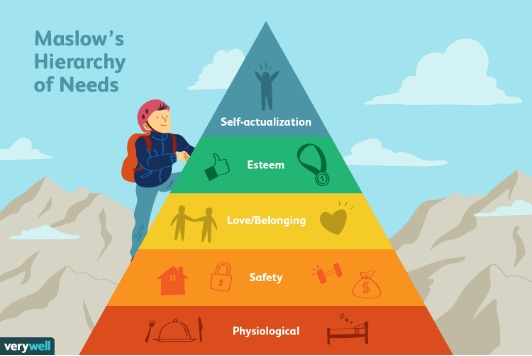
Over several months I started to notice certain stories had the same effect; all addressing this issue of whether a character in a story was in some way unloved. I realised that this girl would not be in a position to learn and grow unless some of these deeper needs were met and addressed first. It took me back to Maslow’s ‘Hierarchy of Needs’ (a theory taken from his paper “A Theory of Human Motivation” published in The Psychological Review, 1943). In it, Maslow proposed that there are progressive levels of basic human needs that we all have. He argued that, in order to be able to reach those higher levels of ‘self-actualisation’, you first have to have a solid foundation rooted in your physical, psychological and emotional needs being met:

Alan De Botton’s book, ‘The School of Life: An Emotional Education’ (De Botton, 2019) further challenged and contextualised my thinking in this area. In his book, he comments on the current educational priorities of society and what we value based on an analysis of the things we seek to formally pass on from generation to generation:

‘The knack of our species lies in our capacity to transmit our accumulated knowledge down the generations. The slowest among us can, in a few hours, pick up ideas that it took a few rare geniuses a lifetime to acquire. Yet what is distinctive is just how selective we are about the topics we deem it possible to educate ourselves in. Our energies are overwhelmingly directed towards material, scientific and technical subjects – and away from psychological and emotional ones. We devote inordinate hours to learning about tectonic plates and cloud formations, and relatively few fathoming shame and rage.

The assumption is that emotional insight might be either unnecessary or in essence unteachable, lying beyond reason or method, an unreproducible phenomenon best abandoned to individual instinct and intuition. We are left to find our own path around our unfeasibly complicated minds – a move as striking (and as wise) as suggesting that each generation should rediscover the laws of physics by themselves.’ 

(De Botton, 2019, p1)

This notion of leaving an emotional education to chance bothered me. If Maslow is right, that people first need to have developed their emotional wellbeing as part of their foundations before they can effectively build structural knowledge on top, then why would we want to prioritise later stages before getting the base level right and strong? The girl I mentioned may have been a more extreme example but the more I read, the more I am convinced that this same need is true for all children.

As I started to look into mental health and wellbeing I noticed a clear societal trend towards a predominantly ‘reactive’ response model. Similar to a fire-fighting analogy, things are largely left waiting until there is an issue with an individual where interventional steps are then taken to try and deal with that specific case. The problem with this way of working is that the amount of manpower and resourcing required is just not sustainable. Current national UK statistics state that 1 in 5 children have a diagnosable mental health condition (DMHC)! Even more concerning for me, is that just 25% of those children with a DMHC are actually getting seen/receiving support (i.e. 75% are not!) as there is just not enough provision available. It must also be noted that this percentage is only accounting for children who have been clinically diagnosed and does not take into account the far greater number of children with growing needs that might not otherwise go on to developing a mental health issue were those needs to be proactively addressed earlier.

Statistics like this can quickly promote a feeling of helplessness and despondency but I was, and continue to be, determined to seek for an alternative. Rather than waiting for mental ill health to raise its ugly head, I wanted to look into this area and seek to find a more proactive and positive response. Is there a way to go back much earlier, way before issues of mental ill health come up, and seek to find ways to promote and develop positive mental health for all young children? I thought about this little girl above and how stories seemed to help get past all her defenses and access that part of her linked to Maslow’s hierarchy of need. This started my journey into wanting to better understand mental health and development in early childhood and explore the role that stories can play.

An overview of mental health: Where are we now and where are we going?

The last decade has seen a significant shift in society’s awareness and attitudes towards mental health. From 2010-2015, a number of changes in UK government public policy sought to recognise the effects of mental ill health both on an individual and societal level. Workers’ rights changed along with the UK National Health Service seeking to adapt to try and meet an increasing need. As certain stigmas and taboos have been challenged, people have increasingly felt more able to access support as well as being able to talk more openly about existing struggles.

The notable change has come in the last 5 years with a move away from mental health being seen as just something negative to encompass a more positive approach. Rather than mental health being the concern of those individuals suffering with ill effects, we are now in an unprecedented era where the notion of mental health as an issue that affects us all is increasingly being promoted and adopted by mainstream media and culture. With the rise of wellbeing as a consumer commodity we have seen the conversation pendulum swinging from a concern for the negative effects of mental ill health to a promotion of the potential benefits of positive mental health and its impact on wellbeing. Campaigns such as ‘CALM’ (The Campaign Against Living Miserably) as well as ‘Heads Together’ have rightly sought to encompass both sides enabling a healthy balance between the two. There is still a long way to go but the agenda of the importance of adult mental health is clearly gathering momentum at a societal/global level which, in time, will hopefully continue to filter its way down into the grass roots of everyday culture.

The ever-increasing openness to adult mental health has subsequently led to a progressive awareness of the effects of mental health in the age bands below. There has been a clear movement in the last 10 years from adults to a concern for teenagers and more recently this has lowered to encompass an awareness of the mental health needs of upper primary (7-11yr olds). With the UK government’s publications such as ‘Future in Mind’ (2015) followed by the green paper ‘Transforming children and young people’s mental health provision’ (2017), we are seeing an acknowledgement of the increasing need as well as the lack of adequate current provision. On the 30th January 2020, Anne Longfield, then UK Children’s Commissioner, released her third annual report into the state of children and young people’s mental health services. This report explained that, ‘while the NHS has made tangible progress in the provision of mental health services for children, the current system is still far away from adequately meeting the needs of all of the estimated 12.8% of children in England with mental health problems – or the many more children who fall just below the threshold for clinical diagnosis’ (Longfield 2020, p1). Whilst discussing the need for provision for children and young people suffering from mental ill health, the commissioner made it clear that ‘prevention’ and ‘early intervention’ must be a key focus. ‘The common story I hear is how mental health issues developed, and very often got worse, before they got any help’ (Longfield 2020, p1). She advocates for a move away from reactive individual responses that are often ‘too little, too late’ and an embracing of a ‘Universal approach’ that seeks to proactively promote positive mental health with a view to prevention for all children.

This view about the importance of proactively seeking to develop positive mental health as a means of prevention is increasingly being acknowledged by other voices within the field. Most significant is the recognition of the impact of this process when specifically targeted within early years and the 0-5 age bracket. Looking at the evidence (as well as multiple recent publications from the UK Government, Ofsted, the NHS, the Children and Young People’s Mental Health Coalition and beyond), I believe we are on the cusp of seeing the main focus of mental health having a major shift ‘upstream’ towards early years and the 0-5 age bracket. The Children and Young People’s Mental Health Coalition (CYPMHC, 2019a) recently stated, in their consultation response for a new 10-year NHS plan, that their top 3 priorities would be: prevention, early intervention and the provision of skills and confidence to recognise and address mental health needs in infants as well as children and young people. It’s worth noting that the CYPMHC decided to use all 3 priorities to stress the importance of early childhood, when in response to a question asking what they felt were the top priorities for meeting the mental health needs of people of all ages in the next 5 to 10 years. This recognition of the power and impact of mental health input in the first 0-5 years of life on a future adult’s life is significant.

Proactive mental health in early years: What young children need to thrive and survive

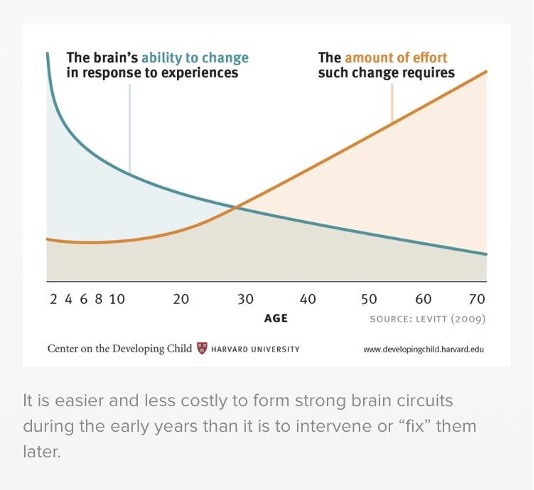
There is an ever-increasing body of scientific evidence within the realms of child development to show how, ‘Early experiences shape the architecture of the developing brain and lay the foundations of sound mental health’ (Center for the Developing Child (CDC), Harvard University, 2018). The CDC goes on to explain how, before the age of 5, ‘Cognitive, social and emotional capacities are all intertwined within the architecture of the brain’. Whilst neuroplasticity enables the brain to make changes over time throughout life, this diagram below shows just how much happens at the start and how much harder it is to make changes as time goes on:

These early foundations formed between 0-5 years have ‘lifelong implications’, so it stands to reason that we should pay significant attention to the input children receive within this time frame. Just as a tree or a house is only as strong as its foundations, so we need to seek to re-address the things we are first prioritising in early child development before adding subsequent layers on top. The National Scientific Council on the Developing Child (2019) suggests that:

‘Sound mental health provides an essential foundation of stability that supports all other aspects of human development – from the formation of friendships and the ability to cope with adversity to the achievement of success in school, work and community life in adulthood. Similar to the way a wobbly table may not function well if the floor is uneven, the legs are not aligned, or the tabletop is not level, the destabilising consequences of problems in mental health can be caused by many interdependent factors. Understanding how emotional well-being can be strengthened or disrupted in early childhood can help policymakers promote the kinds of environments and experiences that prevent problems and remediate early difficulties so they do not destabilise the developmental process.’

Across the world we are increasingly seeing a recognition of the limitations of the reactive model when seeking to address the long-term problems of mental ill health in society. This emerging shift towards a more proactive and universal approach for all children will require a much more long-term view. Reverse engineering to go back and start a renewed focus on early childhood will take time to see results but the evidence is already there to show its measured impact. The NHS’s official endorsement of the work of Laura Earnshaw and ‘My Happy Mind’ (Earnshaw, 2020) is a case in point. There is a desire for resourcing that effectively enables young children to be able to develop positive mental wellbeing. The challenge is to take this overall concept and seek to break it down into practical and clear areas of learning that can be replicated in multiple settings. The ‘What’ and ‘How’ being just as important as the ‘Why’.

Throughout my 20+ years as a teacher, I have come to see certain strands within a child’s development that are a key source and indicator of that child’s future success. These strands are many and multifaceted but I would argue they can largely be brought together and found under one of 3 key headings or themes: Self-esteem, character and resilience.

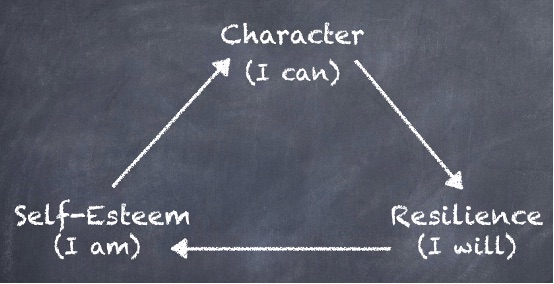
These 3 themes are essentially an interconnected triad or cycle that moves between ‘How I see myself’, ‘How I engage’ and ‘How I respond’.

Self-esteem links to a child’s inner ‘I am’ statements. As humans we all need to have an internal grounding knowledge that we are loved and accepted and of significant value. We need secure attachments and to have a sense of belonging as well as a sense of empowerment and agency to affect personal and external change. It matters how we see ourselves and the narratives we build to help make sense of our worth and where we fit in the world.

Character builds on this sense of ourselves to encompass how we engage with others and the world around us. The publication ‘Nurturing Natures’ describes a child’s natural developmental stages as moving through an awareness of ‘Me’ then ‘You’, then ‘Me and You’ (Music, 2017, p53). Essentially, character is the bridge that enables what’s inside to come out and interact, develop and grow with the external world. These are fundamental skills (or ‘characteristics’ if you like) that children need to have opportunities to develop in order to thrive in this developmental stage and well beyond. The way this is presented to the children is like a toolbelt where you can develop your tools and learn which ones are most useful to use in any given situation. Children do not instinctively have the social, emotional, behavioural or language and communication skills they need to be able to thrive. They need to learn them. Nurturing and growing confidence in young children in these areas is key to being able to take risks and try new things. One only needs to look at the Early Years Foundation Stage Framework (DfE, 2023) in the UK to see how the core principles found in the ‘Characteristics of Effective Learning’ encompass this. It takes courage to step out and engage with the world around us. Having these character tools and skills enables us to minimise potential pressures and stressors, and to maximise our ability and agency to succeed. Alongside the tools to engage with our external world, we also want to empower children with the core tools to be able to unlock, understand and engage with their internal world too. The inner world of thoughts, feelings and emotions can cease to be a daunting mystery and increasingly become a place of safety and strength when we have the tools to do so.

Resilience comes in response to the challenges and setbacks we face and experience as we engage with the world around us. A variety of terms are used synonymously to denote resilience. These include perseverance, grit, determination and stickability. It is important here to acknowledge what resilience is not! It is not the unhelpful notion of being able to ‘suck it up’ or ‘take it on the chin’. Rather than pushing feelings down and keeping on going; resilience is about acknowledging and sharing the pain/challenge/frustrations we face together alongside finding ways to address them, learn from them and move forward one step at a time. A key aspect of resilience is growth mindset (the idea that our intelligence and abilities are not fixed but can be significantly grown through effort). Children with a growth mindset are not afraid to make mistakes and recognise that failure is part of the journey to success. As children grow up, these skills of resilience will enable them to better face the increasing barrage of pressures we humans are expected to deal with on a daily basis and do it together.

The more I have researched, the more I have found these 3 themes of self-esteem (I am), character (I can) and resilience (I will) to be used and recognised as having increasing importance for the future of education and society at large. Both Ofsted and the Minister for Education have recently released papers suggesting that these 3 buzzwords will be part of future expectations for school provision with a particular focus on early years. These themes can also be found in the latest pedagogy of child development as well as child and adolescent psychotherapy, positive psychology and the latest neuroscience research. Under these 3 headings we are able to place a plethora of important strands such as attachment, self-regulation, empathy, fear, social interaction, rejection, emotional literacy, confidence, risk, grief/loss, anger, inclusion and many more. So, if these themes and strands are ‘What’ needs to be embedded; the natural next step is to look at the ‘how’. How can we best provide and maximise opportunities for children to develop these essential skills and aspects of positive mental health?

The role of stories: the science behind the magic

According to Sarah Mears of Empathy Lab ‘Books have a unique power to help us see the world anew, through the eyes of characters whose experiences are very different from our own’ (Mears, 2016). I would add to this that books also have the power to resonate and help us to see our worlds anew through characters whose experiences are similar to our own. Miranda McKearney’s article in the Guardian suggests that, ‘Stories have the power to bring emotions to life, helping children to understand and handle their own feelings and those of others,’ (McKearney, 2015, p1). The key lies in the empathy. According to Mears, ‘A building body of neuroscience research shows that reading fiction can actually expand our brain’s capacity for empathy and theory of mind’ (Mears, 2016). Theory of mind being the capacity to understand how other individuals think and empathy being the capacity to understand how other people feel.

Researchers at Emory University in Atlanta, US, say that ‘Fiction tricks our brains into thinking we are part of the story. The empathy we feel for characters wires our brains to have the same sensitivity towards real people. Carnegie Mellon University studies discovered that when you get lost in a book your brain lives through the characters at a neurological level’ (McKearney, 2015, p1). I think back to the child I mentioned earlier as well as countless others who I have witnessed living out real personal emotions through the portal of a story.

It was Rizzolatti and Sinigaglia (2008) who first discovered the existence of ‘Mirror Neurons’ in our brain that are activated when observing another as a means of empathetic learning. Their experiments originated from seeing how certain parts of a monkey’s brain were activated when watching another monkey eat a banana. The first monkey’s brain would react in a mirrored response to emulate exactly what the other monkey’s brain was doing in response to eating the banana even though it wasn’t personally eating it itself. Subsequent experiments found the same could be found in humans. As well as an effective way to observe and learn practical skills, this is also a powerful way, ‘we learn about emotions, and similar areas of the limbic system, circuitry central to emotional functioning, are activated in both the imitation and observation of emotions. Mirror neurons suggest a human capacity to form powerful connections,’ (Graham Music, Nurturing Natures, p55).

What I find even more interesting and exciting is how music then goes on to acknowledge that this powerful connection does not have to be done in person but can actually be done just as effectively through stories. ‘When Listening to stories about another person’s feelings, brain regions central to empathy and the mentalizing system are activated’, (Music, 2017, p56). In other words, it is possible for children to powerfully engage with a character’s experiences, emotions and issues and learn from them as if they had experienced those things themselves. Often children can find it hard or even scary to engage with their own personal thoughts, fears and difficult emotions (particularly if they have not yet been provided with the emotional language to be able to understand and explain themselves fully) but when presented with a safely removed story they are much more willing to use that as a mirror from which to engage and observe themselves through that character’s experiences. Stories provide children with inspiration for new thinking as well as choice and empowerment within a safe context. This aspect of safety is important.

Bion (1977) talks about the need for infants to have a certain level of containment of difficult emotion by another in order to convey it back in a more digestible way. I believe stories are a perfect way to do this. As Bion suggests, ‘Contained or marked emotions lose their dangerousness, as if “detoxified”, making them less overwhelming’ (Cited Music, Nurturing Natures, p49). A story offers an opportunity for a child to enter and observe a potentially dangerous environment from a safe seat. To feel the full range of emotions from a safe distance and then to take onboard those experiences as if their own.

As Laurie J. Harper states in her article Using Picture Books to Promote Social-Emotional Literacy:

Picture books can provide the framework for building empathy, tolerance and friendships and reinforce social-emotional, problem solving and conflict resolution skills in young children (Kemple, 2004). Sharing high-quality literature with young children provides a range of language to help them identify, label and express emotions. High-quality children’s literature that contains authentic characters, realistic problems and possible resolutions validates children’s emotions while offering models for managing strong emotions. Sharing such literature allows for the discussion of emotion-provoking conflicts and events that may mirror those routinely experienced by children, helping foster children’s resilience and coping skills.

(Harper, 2016)

Harper proposes, ‘a need for high-quality children’s literature that challenges and builds young children’s emotional competency’, (Harper, 2016, p2). To be clear, I do not think we have a shortage of canonical books that already promote emotional competency. What I do think, however, is that there is an ever-increasing awareness and focus on explicitly using stories in this way and incorporating it within a wider context of mental health. Having used literature as a means for teaching throughout my career, I have found stories that work but still think there are specific gaps as well as plenty of room (and an increasing appetite) for much more. Specifically for stories that help children to engage with those 3 umbrella themes of self-esteem, character and resilience. Rather than subtly teaching children life skills through the back door/osmosis; I want children to better understand the tools they are learning in a fun and exciting way so they can explicitly see how to use them, why they are useful and actively choose to use them for themselves because they make their lives better.

Conclusions: Why early years holds the keys to the future of mental health

I truly believe that the proactive promoting of positive mental health in early childhood is going to be a core agenda in the time to come. I also think that, looking at what is already being done in other countries such as New Zealand, Sweden and Canada, this is going to be a priority recognised globally.

The aim of this article is to seek to give a broader context of where we are now nationally and globally with regards to the mental health agenda (currently moving in awareness/openness from adults down to include teens and more recently upper primary) and then show where we are headed based on upcoming government announcements and current research that are due to bring in a big focus on prevention and a new priority for mental health in early years. All this evidence points to the next big thing being mental health in 0-7 year old’s and there is a very good reason for this. As Blair and Diamond (2008) acknowledge, there is so much research to show that the 3 areas of self-esteem, character and resilience are more important as indicators of future adult success than academic achievement in early childhood.

I agree with Alan De Botton that an emotional education is key and should not be left to chance. In keeping with the pedagogy of the early years, this is something to be taught ‘with’ a child, not just ‘to’ them which is why I think stories are the perfect vehicle from which to do this. As Durlak et al (2011) argue, the teaching of personal, social and emotional skills should, ‘not be a ‘top-down’ teaching but rather one of shared experience. This is more in line with a sense of empowerment. Encouraging children to discover and recognise their own strengths as they are modelled through the experiences of another’ (Durlak et al, 2011). As the focus shifts and the mental health needs of young children become the new priority, stories will be one of the key ways to do this. Using those main themes of self-esteem (I am), character (I can) and resilience (I will), we can help future generations of children to build strong foundations that will not easily be shaken.

If you would like to know more, please do feel free to get in touch. I strongly believe that we grow and achieve the most when we do it together. I’m currently writing a book for Routledge where I will go into much more detail (both theory and practice) for how we can best support young children in building strong mental health foundations. I am also moving forward with having my first set of children’s story books published that are all designed to support the above alongside getting ready to launch ‘Yungle’ as a one-stop-shop website for all things supporting children’s mental health so watch this space!

At the core of it all, given the opportunity, I would love to be able to find every way that can help to empower and inspire the amazing children that we teach (as well as the families and broader communities we live in). The aim is not just to equip children with the necessary tools to cope when life’s challenges inevitably come but also to empower them with the foundational skills to be able to thrive well beyond that. Imagine a world where children grow up to be courageously daring and healthily resilient in the way that they face life’s challenges and go after (even beyond) their dreams with a strong internal sense of, ‘I am, I can & I will!’.

Key takeaways

  • We are in the middle of a serious children’s mental health crisis but this is not the end and things are not hopeless!
  • Mental health can be proactive and is not just the absence of mental ill health.
  • We can support children to build their own strong foundations in mental health that will serve as life-long tools to equip and empower them to thrive both now and their future to come.

Critical considerations

  • How does your own personal wellbeing and mental health impact your effectiveness when supporting children?
  • Looking at the stories you have available in your setting – what could be used to support children to develop their own understanding and tools for how they approach their own wellbeing? (E.g. – ‘Ruby’s Worry’ by Tom Percival can help children to learn how best to recognise and build agency in how they see and approach anxiety). Could you invest in some new ones? Link for: Child Mind Institute’s list of Children’s Mental Health Books or Waterstones top children’s mental health story books
  • In the UK early years education system, there are 7 areas of learning (3 Prime areas and 4 Specific/extra areas). ‘Personal, Social and Emotional Development’ is considered a ‘Prime’ area whereas ‘Literacy’ and ‘Numeracy’ are not. Looking at your current setting, would you say the visible priority walking in is the former or the later?
  • Would you say your practice/setting mostly follows a proactive or reactive model for children’s wellbeing and mental health (i.e- do you tend to wait until a child has a problem before looking to fix it or do you look at all the ways you can be supporting children to learn tools and skills well before they visibly need them?)
  • In what ways are you already supporting your children to build strong positive foundations in mental health? Are there any new things you could try?
  • How can we bring parents on board to develop a shared language and journey with supporting children’s mental health foundations?
  •  

Explainer

‘Characteristics of Effective Learning’:  The Characteristics of Effective Learning describe behaviours children use in order to learn. To learn well, children must approach opportunities with curiosity, energy and enthusiasm. Effective learning must be meaningful to a child, so that they are able to use what they have learned and apply it in new situations. These abilities and attitudes of strong learners will support them to learn well and make good progress in all the EYFS (DfE, 2023) Areas of Learning and Development. Source and further reading link: Birth to 5 Matters (Early Years Coalition, 2021).

References

Abdinasir, K. (2019). Making the grade: How education shapes young people’s mental health, Centre for Mental Health, The Health Foundation.

Action for Children (2017). Mental Health Overview: Good Mental Health Starts in Childhood, https://www.actionforchildren.org.uk/what-we-do/our-impact/mental-health-overview/

Big Life Kids (2020). The Big Life Journal: A Growth Mindset Journal for Children, https://biglifejournal-uk.co.uk/

Bion, (1977). Theory of Containment, Cited in Bion’s Theory of Containment, Kleinian Theory, Chapter 12, p165-180, https://www.counsellingfoundation.org/wp-content/uploads/2015/07/Bions-theory-of- containment-Ch12.pdf

Blair, C. & Diamond, A (2008). Biological Processes in Prevention and Intervention: The Promotion of Self-Regulation as a means of Preventing School Failure, Development and Psychopathology, 20(3): 899-911.

Bright, R (2020). The Worrysaurus, Orchard Books, an imprint of Hachette Children’s Group

Centre on the Developing Child (2018). Early Childhood Mental Health: A series of brief summaries of essential findings from recent scientific publications and presentations by the Center on the Developing Child at Harvard University. www.developingchild.harvard.edu/resources/

CYPMHC (2019a). Consultation on a new 10 year NHS Plan: A response from the Children and Young People’s Mental Health Coalition, https://cypmhc.org.uk/wp-content/uploads/2019/11

CYPMHC (2019b). A Manifesto to Promote Children and Young People’s Mental Health, The Children and Young People’s Mental Health Coalition, https://cypmhc.org.uk/publications/

De Botton, A. (2019). The School of Life: An Emotional Education, Hamish Hamilton, Penguin Random House UK, 1st Edition

Department for Education (2023). Early years foundation stage statutory framework for group and school-based providers. Available at: https://assets.publishing.service.gov.uk/media/65aa5e42ed27ca001327b2c7/EYFS_statutory_framework_for_group_and_school_based_providers.pdf (Accessed: 25 August 2024).

Department of Health (2015). Future in mind: Promoting, protecting and improving our children and young people’s mental health and wellbeing, NHS England Publication Gateway Ref. No 02939

Department of Health & Department for Education (2017). Transforming Children and Young People’s Mental Health Provision: a Green Paper.

Durlak, J E. et al (2011). The Impact of Enhancing Students Social and Emotional Learning: A Meta-Analysis of School-Based Universal Interventions. Child Development, 82(1): 405-32.

Early Years Coalition (2021). Birth to 5 Matters: Non-statutory guidance for the Early Years Foundation Stage.  St Albans: Early Education.  Available at https://birthto5matters.org.uk/wp-content/uploads/2021/04/Birthto5Matters-download.pdf

Earnshaw, L. (2020). My Happy Mind, https://myhappymind.org/

Glazzard, J. Potter, M. & Stones, S. (2019). Positive Mental Health: Meeting the mental health needs of 0-5 Years, Critical Publishing Ltd, 1st Edition

Government Statutory Guidance. (9th July, 2020). Physical Health and Mental Wellbeing for Primary and Secondary. Updated 25th July 2020.

Garner, P. & Parker, T. (2018). Young children’s picture books as a forum for the socialisation of emotion, Journal of Early Childhood Research, Vol 16, p291-304

Goodman, A. Joshi, H. Nasim, B & Tyler, C. (2015). Social and emotional skills in childhood and their long-term effects on adult life, A review for the Early Intervention Foundation.

Haig, M. (2018). The Truth Pixie, Canongate Books, 1st Edition

Hari, J. (2018). Lost Connections: Why you’re depressed and how to find hope, Bloomsbury Publishing, 2nd Edition

Harper, L.J. (2016). Using Picture Books to Promote Social-Emotional Literacy, The National Association for the Education of Young Children.

Hinds, D. (2019). Five Foundations to Build Character, The Education Secretary’s address to the Foundation for Educational Leadership Conference, Published on www.gov.uk/government/speeches

Longfield, A. (2020). The State of Children’s Mental Health Services, The Children’s Commissioner’s Report, https://www.childrenscommissioner.gov.uk/report/the-state-of-childrens-mental-health-services/

Longfield, A. (2020) https://www.childrenscommissioner.gov.uk/news/childrens-mental-health-report-warns-chasm-remains-between-what-services-are-available-and-what-children-need/#:~:text=This%20year’s%20briefing%20shows%20that,many%20more%20children%20who%20fall

Maslow, A.H. (1943). “A theory of human motivation”. Psychological Review. 50 (4): 370–96. CiteSeerX 10.1.1.334.7586. doi:10.1037/h0054346 – via psychclassics.yorku.ca.

McKearney, M. (2015). Lost for words? How reading can teach children empathy. Inspiring Teaching. The Guardian Online

McLaughlin, K. (2017). The Year Mental Health Went Mainstream, Spiked Online

Mears, S. (2016). Ten of the Best Books to Boost Empathy. Books For Keeps – the children’s book magazine online.

Music, G. (2017). Nurturing Natures: Attachment and Children’s Emotional, Sociocultural and Brain Development, Routledge UK.

NSCOTDC (2018). Establishing a Level Foundation for Life: Mental Health Begins in Early Childhood, National Scientific Council on the Developing Child, Working Paper 6.

Nikolajeva, M. (2013). Picture Books and Emotional Literacy, Article in The Reading Teacher, Vol 67, Issue 4, p248-254.

Partnership for Well-being and Mental Health in Schools (2017). A response to the Government’s Green Paper: Transforming Children and Young People’s Mental Health Provision.

Rankin, J. (2005). Mental Health in the Mainstream, A good choice for mental health, Institute for public policy research, Rethink, Working Paper Three

Rizzolatti, G. & Sinigaglia, C. (2008). Mirrors in the Brain: How Our Minds Share Actions and Emotions, Oxford University Press

Royal College of Nursing (2014). Mental Health in Children and Young People, Published by The RCN, 20 Cavendish Square, London W1G 0RN

SEAL (2008). The Social and Emotional Aspects of Learning, The department for Children, Schools and Families, 2nd Edition.

Time To Change (2019). Impact Report for Mental Health Changes 2018-19, Time To Change, 15-19 Broadway, London, E15 4BQ

Venters, N. Dr (2018). The past, present and future of innovation in mental health, NHS Digital, NHS Transformation Blogs.

Wroble, A. (2020). Wellness Trends to Watch in 2020, Mintel: Health and Wellness, https://www.mintel.com/blog/personal-care-market-news/wellness-trends-to-watch-in-2020

Young Minds (2018). Addressing Adversity: Prioritising adversity and trauma-informed care for children and young people in England, The Young Minds Trust, Health Education England.

About the author

  • Teacher and Head of early years

    A teacher of over 20 years, Matt currently works as Head of Early Years and Development Lead for a school in South London; teaching full time as well as overseeing wellbeing and mental health for staff and pupils across the school. Alongside this, Matt also runs external training for teachers, senior leadership and parents in London Boroughs and beyond as well as being a speaker on the educational conference circuit. Matt is currently preparing to launch ‘Yungle’ as an edtech hub for proactive mental health resources for children, schools and families and is soon to be a published children’s book author with the first in a series of stories promoting self-esteem, character and resilience tools for children. He is also currently writing a practitioner book for Routledge on how to support children in the early years to build strong foundations in mental health.

    View all posts

Watch the full podcast episode

You might also be interested in...

Follow us and share your voice