Publication date
Author
-
Paula Walshe (she/her)
Assistant lecturer and researcher in early childhood education
The podcast episode goes deeper into all things STEAM by discussing:
Education for sustainable development, encouraging more girls to study STEM subjects, normative gender roles, re-considering our view of technology as not just about screens and digitalisation, embedding an understanding and empathy for the world around them, connecting concepts and theories to practice, STEAM being culturally and historically relevant, making STEAM affordable and accessible for all, the role of AI in early childhood…Listen here.
What is STEAM and why is it important?
Incorporating STEAM activities (science, technology, engineering, the arts and maths) is vitally important in the provision of quality early childhood education for today’s 21st century children. Through STEAM activities children in the early years can learn in a fun and hands-on way and develop valuable skills such as problem solving, critical thinking, collaboration and creativity. These skills are fundamental to children’s learning and development and will support them to become active citizens who are prepared to engage in the world around them. Furthermore, there is an increased focus on STEAM right across the education sector from early years to primary, secondary and beyond (see podcast episode for more on this), therefore, introducing these concepts to even our youngest learners, in a playful way using age-appropriate materials and resources, will prepare them for their life-long learning journey.
Do I have the skills to support STEAM learning?
Many adults worry that they may not have the skills or resources to incorporate STEAM into their early years environment. However, below this article debunks that myth by using baking as an example of a simple activity which, with the use of everyday resources and skills you as educators or parents/carers already have, can foster important STEAM learning in a playful and enjoyable way!
Believe it or not, we all have a perfect environment for STEAM learning at our fingertips, both in our homes and our early years settings…the kitchen!
Let’s explore how baking with young children can not only be great fun but can also promote the development of valuable STEAM skills in an affordable and accessible way.
Science:
Baking is a hands-on experiment in itself and the kitchen is the laboratory, filled with interesting gadgets, receptacles and implements. From pouring and measuring ingredients into a measuring jug or bowl, to observing the transformation of wet and dry ingredients into a dough or batter and then on to becoming an edible delight! By seeing how a cake rises in the oven, children are exposed to scientific concepts such as the chemical reaction of a baking agent with heat and other changes in the physical state of the ingredients. When following a recipe, children learn to follow step-by-step procedures, understand concepts such as cause and effect relationships and develop abstract thinking, problem solving and critical thinking skills.
Technology:
The kitchen provides plenty of non-screen based opportunities to engage with technology. Various tools and gadgets used for cooking and baking are all forms of technology. Children can theorise about, observe and discuss the function of weighing scales, mixers, ovens, timers, and thermometers. Encouraging them to be comfortable with using these tools fosters their technological literacy.
Engineering:
Baking requires following a recipe with precision, which involves the use of engineering skills. Children learn to be adaptable, problem-solve and find solutions when faced with challenges, such as understanding why a cake does not rise, adjusting ingredient quantities, substituting certain ingredients, or modifying cooking times. They also develop spatial awareness by organising ingredients and utensils, rolling dough into different shapes and sizes, choosing appropriately sized bowls measuring jugs or baking sheets, allowing them to cultivate their engineering skills.
Arts:
Baking is the ultimate form of edible art, encouraging creativity and self-expression. Children can design and decorate cakes or cookies and experiment with colour mixing, shape cutters and various patterns. Designing and creating a baked masterpiece together also promotes the development of teamwork and collaboration which contribute to children’s social and emotional development, and sense of confidence and competence.
Mathematics:
Mathematics is a fundamental and integral part of baking. Precise measurement of the various ingredients have a direct impact on the successful outcome of baking. As a result of engaging in baking, children learn about sequencing and the order which ingredients must be added, lists, measurement, counting, temperature, weight, shape, size and dimension. Baking can also help children to understand the concept of time by setting the oven timer and leaving the final product to cool for an appropriate amount of time before eating.
Baking as a perfect hands-on STEAM learning activity
To conclude, baking with young children provides an enjoyable and enriching experience that promotes the development of numerous STEAM skills such as hypothesising, observing, experimenting and calculating. Baking is a wonderful way for children to engage in hands-on learning using real materials to spark their curiosity and nurture their creativity. By incorporating baking activities in early childhood education, educators can lay a strong foundation for children’s future success in science, technology, engineering, arts, and mathematics. So why not whip up a batch of muffins or cookies with your little ones today and watch as their STEAM skills rise like a perfectly baked cake!
Key takeaways
- STEAM activities do not have to be complex or expensive and do not necessarily require additional training.
- You can incorporate STEAM activities easily and effectively into your early years setting or home using affordable and accessible resources.
- To learn more about easy ways to incorporate STEAM, check out Paula’s book below
Critical considerations
- How can I make STEAM learning more accessible in my setting?
- What simple, everyday activities am I already doing that could be reframed as STEAM learning opportunities?
- How can I encourage children to see science, technology, engineering, the arts, and mathematics in their daily experiences?
- Do I have any unconscious biases about who engages in STEAM? Am I actively encouraging all children, including girls, to explore and enjoy STEAM-related activities? How can I challenge gender stereotypes and promote inclusivity in STEAM learning?
- Am I considering technology beyond screens? How can I help children develop an understanding of technology as more than just digital devices?
- What hands-on tools and processes in my environment can help children explore technological concepts in practical ways?
- How can I embed STEAM learning into play-based experiences?
References and further reading
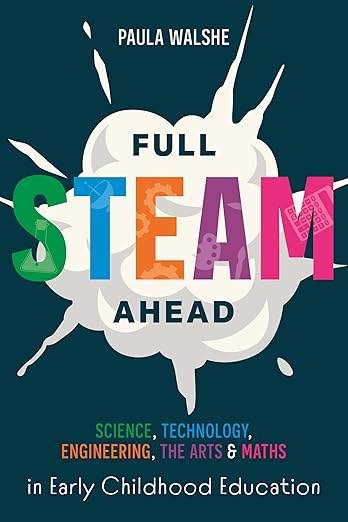
Walshe, P. (2024). Full STEAM Ahead: Science, Technology, Engineering, the Arts and Maths in Early Childhood Education. Tipperary: Boru Press.
This practical book explores why STEAM is important in early childhood education and care (ECEC) and how educators can introduce STEAM activities into the early years environment to support the learning and development of children aged 0 – 6.
Watch the full podcast episode
About the author
-
Assistant lecturer and researcher in early childhood educationView all posts
Paula Walshe is a published author, assistant lecturer in early childhood education at South East Technological University in Carlow, Ireland, and a PhD candidate at Dundalk Institute of Technology. Her PhD research focuses on STEAM (science, technology, engineering, the arts and maths) in early childhood education and care (ECEC). Paula's most recent book, entitled "Full STEAM Ahead" is a guide to implementing STEAM in the early years.