Author

Self-regulation: Where Are We Now?
Self-regulation (SR) continues to enjoy the limelight as one of the latest buzzwords in the world of early childhood education and care (ECEC). As someone who has championed this concept for well over a decade and often feeling alone in this endeavour, it is generally a positive thing. However, as with all concepts entering ECEC, it can be misunderstood, open to myths and misapplied in daily practice.
This was brought home to me during a conversation with the deputy head teacher of a primary school, who proudly told me that ‘since working with consultants, they now build SR in to their understanding of behaviour.’ Ok, so far so good. And that ‘only after three strikes, a letter goes home to parents’. Not so good! You see, the concept of SR is diametrically opposed to behaviour management strategies – or at least, it certainly should be. This is because SR must be understood in terms of an individual’s ability to regulate (or manage) their thoughts, feelings and behaviour.
Hughes and Baylin (2012: 50) are unequivocal about what SR is – and what it is not:
What is self-regulation? We’ll begin with what it’s not: it is not suppression. Rather, it is the resilient capacity to ‘feel’ and ‘deal’, to experience a full range of affect and to modulate all kinds of feelings effectively enough to trust oneself to be able to cope well with the full range of human experience and to be an emotionally trustworthy partner and parent.
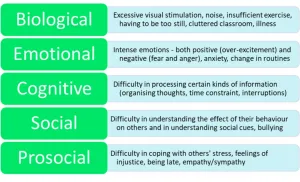
Excessive, toxic stressors in early childhood can negatively impact a child’s stress reactivity. When we take a moment to reflect on SR as existing across five domains, it is easy to see how frequently children can be triggered – and how this is often mistaken for ‘poor’ or ‘challenging’ behaviour to be punished.
Take a look at the table below. It outlines the five domains of SR and just a few of the commonly encountered triggers for children.
Consider children who have been exposed to adverse childhood experiences (ACEs) and those who are neurodivergent. These children disproportionately represent those who are at the receiving end of reprimands and punishments both at school and at home. We need to go beyond the quick-wins of behaviour management which, while succeeding in getting compliance through threats of public humiliation and promises of points and privileges and invest in building children’s mental health. At its root, this involves co-regulation (CR).
Co-regulation – It Takes Two, Baby!
So how can children learn to regulate their thoughts, feelings and behaviour? You are the key! SR is not ‘a given’. Its development wholly depends on the experiences of co-regulation (CR) that a child receives.
The CO-REG acronym below provides a quick reminder of the steps to follow when co-regulating children.

Source: Conkbayir, M. (2022). The Neuroscience of the Developing Child: Self-Regulation for Wellbeing and a Sustainable Future. London: Routledge.
The type of CR you provide will depend on a host of factors that you need to consider, these being:
- The process of CR is not static. It is ever-evolving in line with the child’s age and stage of understanding
- CR is not a one-size-fits-all approach – what works with one child, may not work with another
- What works with one child on one occasion, may not work with the same child, the next time
- The effectiveness of the CR you provide is heavily dependent on your emotional state and mental health at the time
- Your knowledge of the child’s stressors and ability to minimize or prevent these from triggering them.
Top Tips for Practice!
- If SR is yet to be embedded within your provision, in your next team meeting, introduce it and talk about how you currently support children’s ability to self-regulate
- Support your team (and parents) to understand that emotions drive behaviour
- When you are next at work, take a close look at your setting (indoors and outdoors) and note down all the potential stressors for children
- With the support of your team (including the leadership team), plan how you will address these stressors
- Set the tone first thing in the morning – when children see and sense that you are relaxed and truly welcoming, they will feel calm, happy and ready to explore.
Self-regulation – Do You Sink or Swim?
This is a question I often ask practitioners and primary carers and in most instances it does tend to elicit some awkward responses, as if struggling with SR is something to be ashamed of – which of course is not the case. Inviting adults to reflect on how effectively they can manage their own thoughts, feelings and behaviour and how they overcome stressors in their lives can provide some insight into how adept they are at co-regulating others, so it is a dialogue we should all be encouraging and engaging in honestly. While we all have ‘off-days’, with minimum capacity to stay calm and support others, if this is our norm, we will not be best positioned to co-regulate babies’ and children’s emotions and behaviours. Put simply:
We cannot co-regulate if we cannot self-regulate
Moreover, left unresolved, poor SR will have a long-term negative impact on psychological and physiological health, with potentially compromised ability to build and maintain personal and professional relationships and dependence on alcohol, cigarettes and recreational drugs to self-soothe in the absence of self-regulatory capacity.
So, how do you fare when it comes to self-regulating – particularly during stressful moments? This leads us to your journey along the Stream of Self-Regulation.
The Stream of Self-Regulation
This Stream of Self-Regulation, below, provides a quick and easy way for you to identify how effectively you self-regulate your emotions and behaviour. The Stream helps to raise your self-awareness and ability to reflect on any areas that you might need to work on, without the inclusion of numbers and scales, so as to remove any pressure of scoring points. It is a simple tool with recommended strategies to help you easily navigate your way through your personal self-regulation journey. (One of the strategies referred to, the Keep Your Cool Toolbox, is a free SR app that I designed. Its website address can be found in the further reading list).
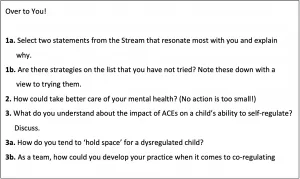
Take a look and answer the questions that follow…

Concluding thoughts
This article has presented you with diverse issues to reflect on concerning the importance of CR in the development of SR and the fundamentally important role of the adult’s own ability to self-regulate. While obstacles are expected when challenging and changing existing practice, your knowledge and conviction will be vital in getting your team and families on board when it comes to creating co-regulating environments as a core part of your SR-informed provision.