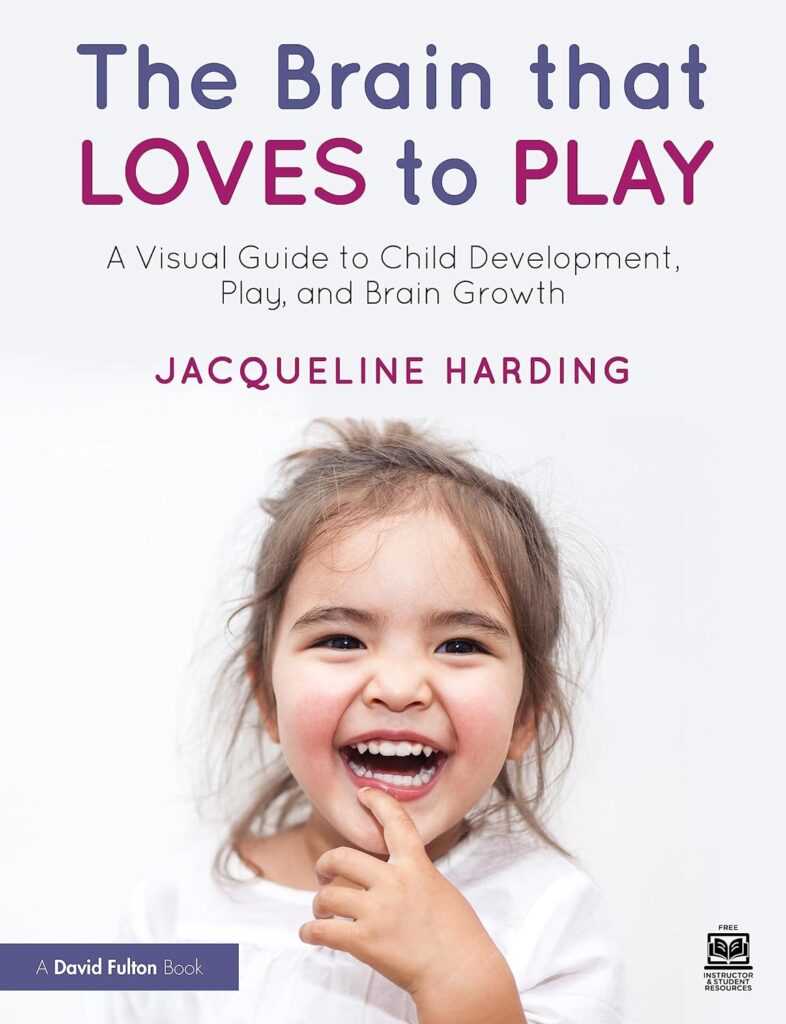
In this podcast we discuss just how play is an exciting choice of ‘food’ for the brain. The brain that loves to play is driven by a biological drive and we now know that when children engage in rich play opportunities, such as fantasy play or rough and tumble play – this can lead to an improved ability later on to navigate the ups and downs of life. The human brain is highly sophisticated as it controls all the body’s functions and allows little ones to engage their senses in a meaningful way.
Why is play important for brain development?
The functioning of the brain is key to the important task of interpreting sensory input from the world. High quality play also helps to build the higher cognitive functions in the brain, such as emotional regulation and inhibitory control (all very important skills in adult life).
The most stunning revelation for me while researching and writing this book, was the neurological understanding of what happens in a child’s brain when it starts to ‘imagine’. Obviously, we will want those imaginative experiences to be light, absorbing and positive.
Firing up the brain
Supporting children in placing themselves in a safe imaginative space through stories, role play, or creative pursuits can sprinkle that bit of stardust that ignites and fires up the brain. So, the developing brain changes its own architecture according to the experiences in the environment and from interactions with others. Every day matters – early experiences matter. When little ones feel safe and allowed the space to be imaginative – then deep things occur in the brain giving it the best start in life.
Play – brain building material
Do children need to play? Absolutely. It is as vital to them as the air they breathe. Spontaneous play in early childhood is the way that the human biological system unwinds and sorts itself out. Play is the fabric of brain building material. When children are immersed in a playful activity, they are building a wealth of experiences that can build strong mental models of the world. It also helps with executive function and higher order thinking, such as critical thinking.
Children benefit more than we have ever truly thought from the sheer act of ‘simply playing’. The young developing brain derives such pleasure and metaphorically lights up when play is on the horizon. It wallows in play activities and games which are self-chosen. This kind of ‘play agency’ is empowering and helps connect those busy neurons in the brain.
Sadly, play remains underestimated for the immense power it can yield in supporting all round learning. Neuroscience is now beginning to provide us with a glimpse of what really is at stake. Play is the bedrock of a child’s development so I wrote this book to offer practitioners, students, and parents the inspiration to give play space and time whenever and wherever possible. I felt it was important to ‘keep it real’ so instead of making films in movie style which can intimidate families, I decided to use ‘fly on the wall’ footage taken on phones which capture snapshots of real play scenarios with young babies and children playing in real homes. The photographs also capture the essence of how activities impact children as they play. These films form the basis of everything I explain and provide a bridge between the theory and the practicalities of everyday life so that the brain that loves to play can flourish.