Publication date
Authors
-
Professor Sam Wass (he/him)
Neuroscientist and Director at Institute for the Science of Early Years -
Dr Gemma Goldenberg (she/her)
PhD Researcher
Enquire about working with Dr Gemma Goldenberg or Professor Sam Wass
Why won’t they just pay attention?
Has a child ever asked you a question that you’ve just explained 2 minutes ago? Or do they seem to ignore you when you give instructions or call their name? Do children constantly fidget during carpet time, or flit from one activity to another without really engaging and persisting at anything? If this sounds familiar, you are not alone. Colleagues and friends who have children or those working in the early years sector increasingly tell us that they are really struggling to capture and maintain children’s attention, and that it’s both exhausting, and frustrating.
Can you ‘test and train’ attention skills?
Previously, researchers and psychologists thought of attention as being like a ‘mental muscle’. Tests were designed and carried out with children in a laboratory, to assess how strong this ‘mental muscle’ is in different children, comparing scores to decide what was ‘normal attention’ and what wasn’t. If a child struggled with attention, psychologists thought this could be improved with attention training, using computer-based programmes which gave the attention muscle a good ‘workout’. But we now know from more recent research (Gobet & Sala, 2019; 2023), that this approach doesn’t really work.
Paying attention to a computer program in a lab is nothing like paying attention in ‘real life’ situations, so the results of these studies don’t transfer well to the ‘real world’. We also know now that children’s ability to pay attention isn’t just about the strength of a ‘mental muscle’ in their brains, but depends on a whole range of other factors such as how stressed the child is, how noisy the environment is, what the activity is and how much they enjoy it, how complex the material being presented is, and so on.
Rethinking attention
So now, we want to encourage thinking about attention in a new way –instead of seeing it as a ‘pure’, cognitive process that only takes place inside the brain, instead let’s think about how it’s related to the whole child – their emotions, interests and motivations, their levels of arousal, and even the physical features of the learning environment around them. We know that all of these things can have a knock-on effect on how well children can concentrate.
The good news is, that when we think about attention in this way, we don’t situate it as a ‘problem’ that’s within the child’s brain and impossible for us to influence. Instead, we can start learning about the little tweaks and adjustments that we can make to the environment, our pedagogy and the activities we offer, to maximise children’s chances of being able to pay attention. For example, did you know that research studies have shown that reducing the amount of displays and posters on the walls increases on-task behaviour and learning performance? And that you might be able to tackle attention difficulties by learning about how to recognise when a child is over or under aroused, and using strategies to increase or reduce levels of stimulation?
We also know from neuroscience research that how difficult the activity or learning material is, and even how predictable it is, all affects how well children can pay attention to it. We can use this to make adjustments which support children to focus better. We discuss this in more detail in the podcast episode.
An attention ‘deficit’ or ‘too much’ attention?
Although we often hear about attention ‘deficits’ in children, newer research suggests that children often have ‘too much’ attention rather than not enough. The difficulty is in learning how to control the focus of that attention and decide what to focus on, and what to filter out. This process is much more difficult for young children than it is for older ones. Understanding why this is the case, and what’s happening inside the brain when children are trying to pay attention, can help us understand things from the child’s perspective, and create an inclusive environment which is more optimal for attention development.
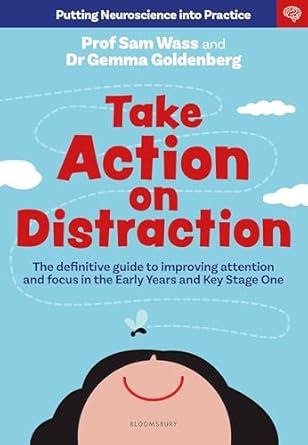
Listen to the podcast episode and read more in our book ‘Take Action on Distraction’. You can receive 25% off the book by entering DISTRACTION25 at the checkout on the Bloomsbury website (valid until 31st august 2025).
Key takeaways
- The way that psychologists and neuroscientists view attention is starting to change. We no longer think about attention as a ‘pure’ cognitive skill that can be tested, measured and trained in a laboratory.
- A child’s ability to pay attention is related to lots of factors such as the physical environment around them, the content and difficulty of the material and the child’s level of arousal.
- Understanding more about this can help educators support children who struggle with their focus and concentration.
Critical considerations
- Do I have a good understanding of what attention is and how it develops?
- Is my learning environment optimal for supporting focus and concentration?
- When children are struggling to pay attention, do I have a toolkit of research informed strategies I can draw upon to help them refocus?
Explainer
Under or over-aroused – arousal in psychological terms relates to how much activity there is between the brain and network of nerves around the body i.e. how stimulated is the child? Under arousal can look like disinterest and fatigue, over arousal can look like stress and overwhelm.
References and further reading
Compass Fostering, 2026. How Much Screen Time Is Too Much for Children? Available at: https://www.compassfostering.com/advice/screen-time-and-child-development
Gobet, F. and Sala, G., 2023. Cognitive training: A field in search of a phenomenon. Perspectives on Psychological Science, 18(1), pp.125-141.
Wass, S. and Goldenberg, G., 2024. Take Action on Distraction: The Definitive Guide to improving attention and focus in the Early Years and Key Stage One.
Understand attention and how it works to help children improve and self-regulate their focus. Take action on distraction and never battle for children’s attention again!
Written by experts in psychology and neuroscience, Take Action on Distraction helps you understand how attention works and shows you how you can work positively with all children in early years and primary settings to improve their focus and concentration. Discover accessible insights from research, practical tips for your classroom and reflective questions to discuss with children and colleagues, all helping you to create a calmer, happier and more effective learning environment.
Watch the full podcast episode
About the authors
-
Neuroscientist and Director at Institute for the Science of Early YearsView all posts
Professor Sam Wass is a child psychologist and neuroscientist who studied at Oxford, London, and Cambridge. He leads the Institute for the Science of Early Years in East London, which is one of the most demographically diverse areas of the world, and a major focus of their research is to explore how early living environments influence early attention, learning and stress. He studies typical and atypical development, including ADHD, Autism, and anxiety, and collaborates on international projects studying early development. Sam has published over 100 academic articles and a book. He frequently appears in the media as an expert in child development, advising the UK Departments of Education and Health, charities like Save The Children, and brands such as Kinder, LEGO and Disney+. He was an on-screen scientist in five series of Channel 4’s award-winning The Secret Life of 4- and 5-Year-Olds.