Author
Raising happy, healthy, successful children with the Core4Connectors – A relationship-based approach.
What is your deepest wish for your child?
Over the last twenty-five years of my early childhood career I asked this question of every parent, teacher, and caregiver I worked with. The answer, with few exceptions, was some version of, I just want them to grow up to be happy, healthy, and successful.
Wow. That is a big just.
And yet, it is human nature to feel this way. To want to do better for and create more opportunities so the next generation can become happier, healthier, and more successful versions of us.
But wait, there appears to be more.
In recent years, the narrative has begun to shift. Parents, especially those raising children in today’s complex, fast moving world, are shifting their language. Instead of naming what they want their children to become, they are telling me how they want their children to feel.
What is your deepest wish for your child? I want them to feel seen, heard, and secure in who they are.
What began as an educator’s curiosity quickly became a social psychology experiment and, eventually, a litmus test for a child’s long-term success in school and life.
This generational shift marks a move away from celebrating external, quantifiable success towards intrinsic wellness. It’s not that parents no longer value happiness, health or achievement, it’s that they recognise those outcomes are built from the inside out. Feeling safe in relationships, emotionally understood, and deeply connected becomes the fertile ground from which confidence, resilience, and fulfilment naturally grow.
But how?, they inevitably ask. The answer is both painfully simple and deeply complex. Prioritise your relationship and start at birth.
Parents as teachers and relationship models
Neuroscience supports what many parents intuitively feel. Early relationships don’t just influence development, they wire it through thousands of everyday interactions. Infants and toddlers build neural pathways based on how consistently their caregivers respond to them.

All rights reserved. Image property of Cara Tyrrell and Core4Parenting
This process, referred to in early childhood education as serve and return, strengthens the architecture of the developing brain. When adults respond with presence, attunement, and meaning-based language, children form beliefs about themselves, others, and the world. These early patterns become the emotional and relational blueprint they carry forward, shaping how they regulate emotions, build trust, and engage in relationships for the rest of their lives. As a trusted adult in a child’s life, you have a unique opportunity to design the relationship.
As a live-in nanny, a classroom teacher, and most importantly, a mother of adult girls, I’ve identified three organic relationships we navigate over the course of our lifetime.
- Self — Our journey to self is long, complicated, and fulfilling when we finally choose to be in-relationship with our best self (no matter what anyone else thinks).
- Partner — Love of self leads us to attract, then create, a very intentional relationship with our other half. Crafting this connection can be just as complicated as arriving at our true self.
- And then there are our children, true products of 1 + 2 = 3. Personally, I believe these three relationships are interconnected, woven together so intrinsically that one cannot exist without the others.
The Core4Connectors: Relating vs. being in-relationship
As humans, we relate to others all day long, yet we are not in-relationship with most of them. We interact. This is an important distinction.
You are the architect of their earliest years: their mind, body, and spirit. If you want your children to grow into happy, healthy, successful adults they must first experience happy, healthy, successful interactions every day.
Think about a typical day in your life. You interact differently with acquaintances, coworkers, and strangers than you do with the few people with whom you share deep love and connection. Those are rare relationships, built on safety, honesty, and mutual respect. This is what it means to be in-relationship.
Think of someone in your life with whom you share that bond. You can be fully yourself. You trust that whatever arises, you can tell them the truth and you’ll navigate it together. This is the Core4Connector-based relationship parents are increasingly prioritising for their children. 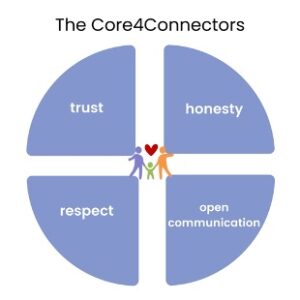
All rights reserved. Image property of Cara Tyrrell and Core4Parenting
When you prioritise being in-relationship with children from birth, they thrive, because brains wire around connection, safety, and collaboration.
You empower their inner voice. I’m allowed to be me. You are allowed to be you. My voice matters and so does yours. We can work together to solve problems. This is the foundation of intrinsic wellness, the kind that sustains children long after external measures of success fade.
My words aren’t working, what about my authority?
For generations, parenting was framed as a power hierarchy, a struggle waiting to happen. “Just wait for the terrible twos!”, you’re told from the moment you announce your pregnancy. “Oh, if the toddler years are this hard, the teenage years are going to crush you!”
Good news! Just because ‘they’ say it’s true does not mean it has to be your reality.
The truth is collaborative parenting does not mean permissive parenting and intentional language is used as a tool for connection, not correction. The words we choose, the tone we use, and the way we engage in challenging moments signal safety or threat to children’s developing nervous system.
Directive, controlling language may achieve short-term compliance, but meaning-based, relational language builds the long-term trust and cooperation today’s parents are seeking. Over time, children internalise not just what we say, but what our words imply about their worth, their capability, and their identity.
If we engage children from a one-sided power position, the struggle is inevitable.
Because I said so.
Don’t talk back.
Do as I say, not as I do.
When children naturally seek autonomy, as they are developmentally wired to do, conflict erupts. The goal is not to live a conflict free life with children. The goal is to build a strong bond and confidently navigate conflict together.
The way you start is the way you finish.
Let’s start strong.
Let’s finish strong.
Let’s raise world-ready children who don’t just look successful, they feel accomplished.
Collaborative parenting begins at birth and it evolves alongside our children through toddlerhood, adolescence, and into adulthood, because children who grow up feeling secure in relationships are more likely to approach the world with curiosity rather than fear, translating to future success in classrooms, friendships, workplaces, and communities.
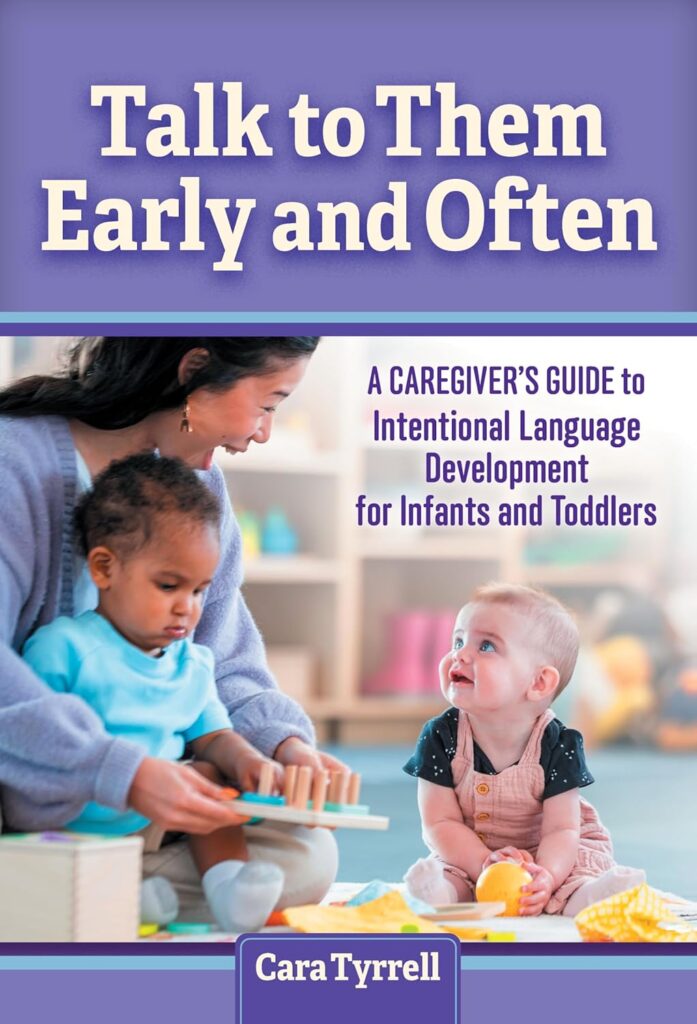

About the author