A deep disconnect
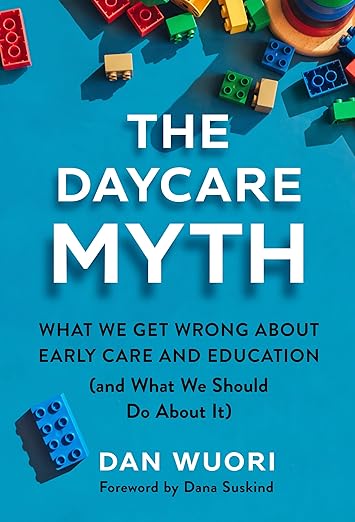
For over thirty years, I’ve worked across nearly every level of the early childhood profession – from hourly educator in a childcare setting to a policy advisor working directly with governors and state lawmakers. Along this journey, I’ve come to see the deep disconnect between what we know about young children and what we do as a society. This growing awareness is what led me to write The Daycare Myth: What We Get Wrong About Early Care and Education – and What We Should Do About It.
At its core, the book challenges the long-standing divide between ‘care’ and ‘education’ in the early years. For much of the past century, society has treated early childhood as a separate – and lesser – phase, with formal education arbitrarily beginning at age five. But we now know, through decades of research and advances in neuroscience, that learning begins well before birth. Children are not waiting to become learners – they already are.
Care and education are inseparable
The term “daycare” has become something of a four-letter word within the early childhood community – and for good reason. We don’t care for days; we care for children. But in truth, even the term “childcare” might not fully capture the scope of what high-quality early environments offer.
Too often, policies still reflect outdated assumptions that view early care as a form of industrialised babysitting – a place for children to be kept while their parents work. But if we truly understand that all environments are learning environments, then we must also understand the profound implications this has for practice, training, and policy. Our youngest children deserve more than custodial care – they need relationships, rich learning, and consistent, skilled educators.
The early years workforce: Essential, yet undervalued
In my career, I’ve been fortunate to teach kindergarten – an experience I still count as the most joyful and rewarding of my life. And yet, the opportunities I’ve had to influence systems and support children at scale – from district to state to national levels – have reinforced the urgent need to reform how we value and support the early years workforce.
It is deeply troubling that infant and toddler educators, those who literally help co-construct children’s brains, are paid an average of $13.22 an hour in the US – less than the national average for dog walkers. This is not only unjust, it’s unsustainable. With nearly 40% of infant–toddler educators leaving the field annually, it is clear that we do not have a staffing crisis – we have a compensation crisis. This is also unfortunately a very similar picture to the UK.
The early childhood profession requires – and deserves – a system that recognises its complexity and importance. From secure attachment to early literacy, infant educators are laying the foundations for lifelong development. If we want better outcomes for children, we must invest in the people who nurture and educate them.
Gender and representation: Men belong here too
As one of the few men in the profession, I often find myself reflecting on how I came into this work. My path began unexpectedly, filling in at an afterschool programme when I was still working in radio. But from the moment I entered that room of energetic, curious children, I knew I had found my calling. And yet, decades later, I still attend conferences where I am one of only a handful of men in the room.
This is not a call to simply recruit more men for the sake of diversity. Rather, it’s a call to expand the image of who belongs in early childhood education. If more men had early exposure to the joy and meaning of this work, many would choose to stay. But without addressing the underlying issues – particularly pay and professional respect – representation will remain stagnant.
Changing the narrative
Ultimately, The Daycare Myth is not just about language. It’s about shifting the narrative – and the systems – to align with what we know about children, learning, and development. It’s about calling attention to the mismatch between our values and our policies. And it’s about honouring the professionalism, skill, and commitment of those who do this vital work every day.
I’ve had the privilege of seeing children I once taught now raising their own families – a reminder of the long arc of influence that educators have. For those starting out in the profession – or for those wondering if the struggle is worth it – I say this: it is. The joy of this work is profound, and the difference you make is lasting.
But that joy should not come at the expense of stability, respect, or fair compensation. We must do better – for children, for educators, and for the future we all share.