Understanding the purpose and potential of EYPP
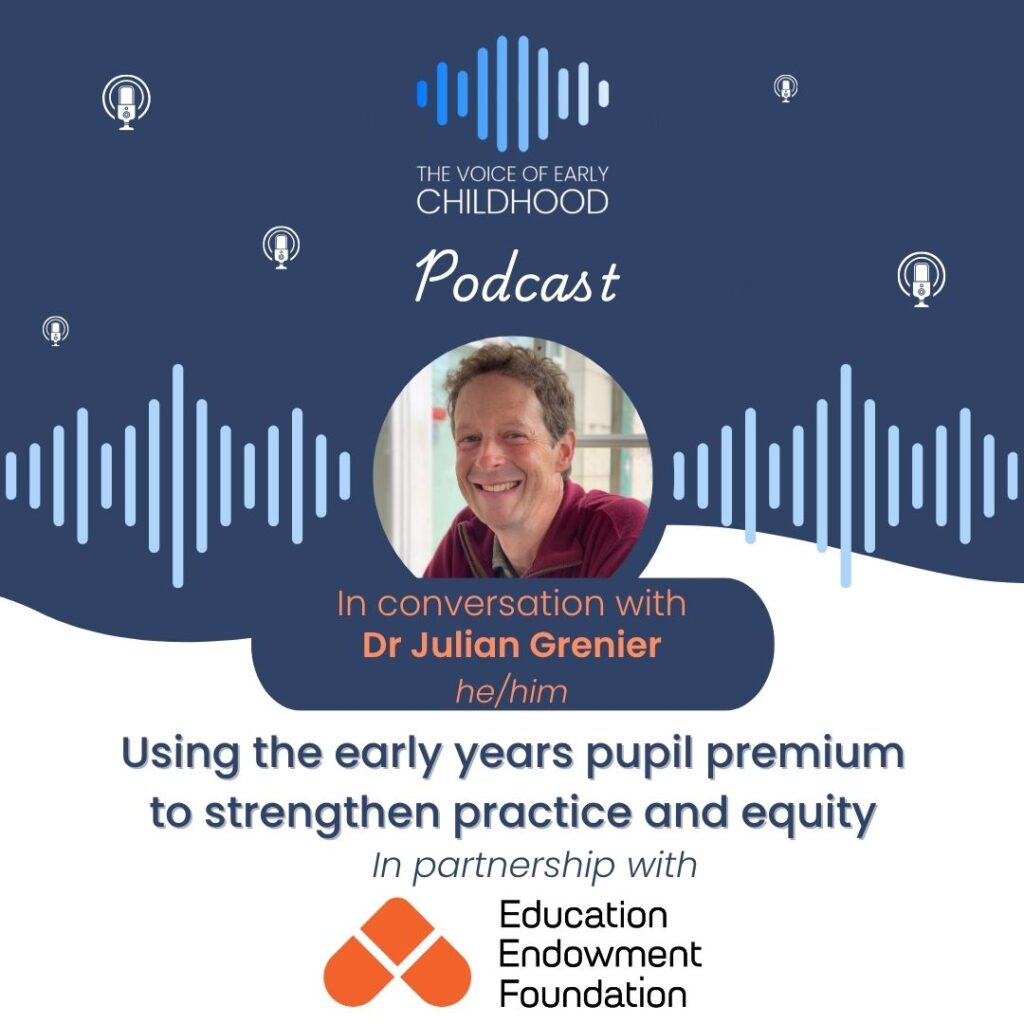
The early years pupil premium (EYPP) offers an important opportunity for the early childhood community to make a meaningful difference to children’s lives. At its core, EYPP is additional funding for providers working with children aged two, three and four whose families may be experiencing economic disadvantage, or who have experienced care or adoption. Yet, despite its potential, awareness and use of EYPP remains uneven across the profession.
In this article, I want to reflect on what EYPP is, why it matters, and—most importantly—how we might use it in ways that genuinely support children’s learning, development and wellbeing.
Starting with relationships and understanding
Accessing EYPP begins with knowing families well. This can sometimes feel uncomfortable. Conversations about financial circumstances may seem intrusive, particularly when educators are working hard to build trust. However, these conversations are not about curiosity for its own sake; they are about ensuring children receive the support they are entitled to.
Strong, respectful relationships with families create the conditions where these discussions can happen naturally. When families understand that EYPP funding can directly benefit their child—and the wider group—they are far more likely to engage. Trust, in this sense, becomes both the foundation and the mechanism for equity.
Why EYPP matters: the bigger picture
The rationale for EYPP is grounded in a well-established body of research: child poverty is associated with poorer outcomes in health, early learning and later attainment. This is not about blaming families, nor about adopting deficit narratives. Many families provide rich, nurturing environments despite significant challenges.
However, at a population level, the pattern is clear. If we are serious about creating a fairer system, additional support must be directed towards those children who are most likely to face barriers. EYPP is one part of that wider effort.
Importantly, early intervention works. High-quality early years provision can have a transformative impact, particularly for children from disadvantaged backgrounds. EYPP gives us a practical tool to act on that knowledge.
Moving beyond resources: what really makes a difference
A common instinct is to spend EYPP on additional resources or experiences targeted at individual children. While this is understandable, the evidence suggests that the most significant impact comes not from what we buy, but from what we do.
High-quality interactions, sustained shared thinking, and skilled teaching are the key drivers of children’s progress. Investment in professional development—such as sustained programmes that strengthen educators’ practice—has been shown to improve outcomes for all children, with particularly strong benefits for those eligible for EYPP .
This presents a powerful shift in thinking. Rather than isolating EYPP as something “extra” for a few children, we can use it to strengthen the overall quality of provision. In doing so, we create environments where all children thrive, and those who need the most support benefit the most.
Balancing universal quality with targeted support
This does not mean that individual needs should be overlooked. Some children will require more focused support alongside improvements in overall quality.
For example, children with less experience of back-and-forth conversation or shared reading may benefit from targeted interventions, such as additional time with an educator for shared book reading. In such cases, using EYPP to support staffing or access to high-quality texts can be entirely appropriate.
The key is professional judgement. Educators must draw on both research evidence and their deep knowledge of children and families to decide how best to allocate resources.
Working as a team: a whole-setting approach
Effective use of EYPP is not the responsibility of one individual. It requires a shared commitment across the whole team.
The Education Endowment Foundation (EEF) planning tool has been developed to support this process, encouraging teams to reflect together on priorities, approaches and impact. One of its central messages is that change is most effective when everyone is involved from the outset. When educators feel
ownership over decisions, they are more likely to sustain and embed them in practice .
This collaborative approach also supports ongoing reflection. Using EYPP effectively is not a one-off decision but a continuous process of planning, reviewing and adapting.
Thinking about impact in meaningful ways
Measuring impact in the early years is complex. Not all outcomes can—or should—be reduced to numbers. However, this does not mean that impact cannot be understood.
Where appropriate, structured tools (such as language assessments) can help identify children who may need additional support and track progress over time. Equally important is observational assessment: understanding what children can do, what they are learning, and how they are engaging.
Focusing on key concepts—such as children’s developing communication, or their understanding of early mathematical ideas—can provide meaningful indicators of progress. These are not narrow outcomes but foundational aspects of learning that support children’s longer-term development.
Rethinking school readiness
Few terms generate as much debate as “school readiness”. It can be interpreted in many ways, sometimes narrowly.
Research suggests that strong provision does not separate children’s social and emotional development from their cognitive learning. Settings that support children’s confidence, relationships and independence also tend to support their communication and early mathematics effectively.
Rather than focusing on a limited definition of readiness, it may be more helpful to think in terms of holistic quality. This includes:
- warm, responsive relationships
- secure routines and environments
- rich opportunities for play and interaction
- thoughtful support for communication and early learning
In this sense, readiness is not a checklist but a reflection of a child’s overall experience.
Towards greater equity in early childhood
There remains a persistent gap in outcomes between children from different socioeconomic backgrounds. EYPP is one way the early childhood community can respond to this challenge.
Encouragingly, there is growing investment, stronger evidence about what works, and a shared commitment across the profession. There are also many examples of settings and communities where children thrive, even in the face of disadvantage.
The task ahead is to build on this knowledge: to use EYPP not as an isolated funding stream, but as part of a wider, thoughtful approach to improving quality, strengthening practice, and supporting every child.